We’ve been trained to talk about the economy like it’s a scoreboard: the Dow, the S&P, quarterly reports, “consumer confidence.” Those things matter, especially if you own assets.
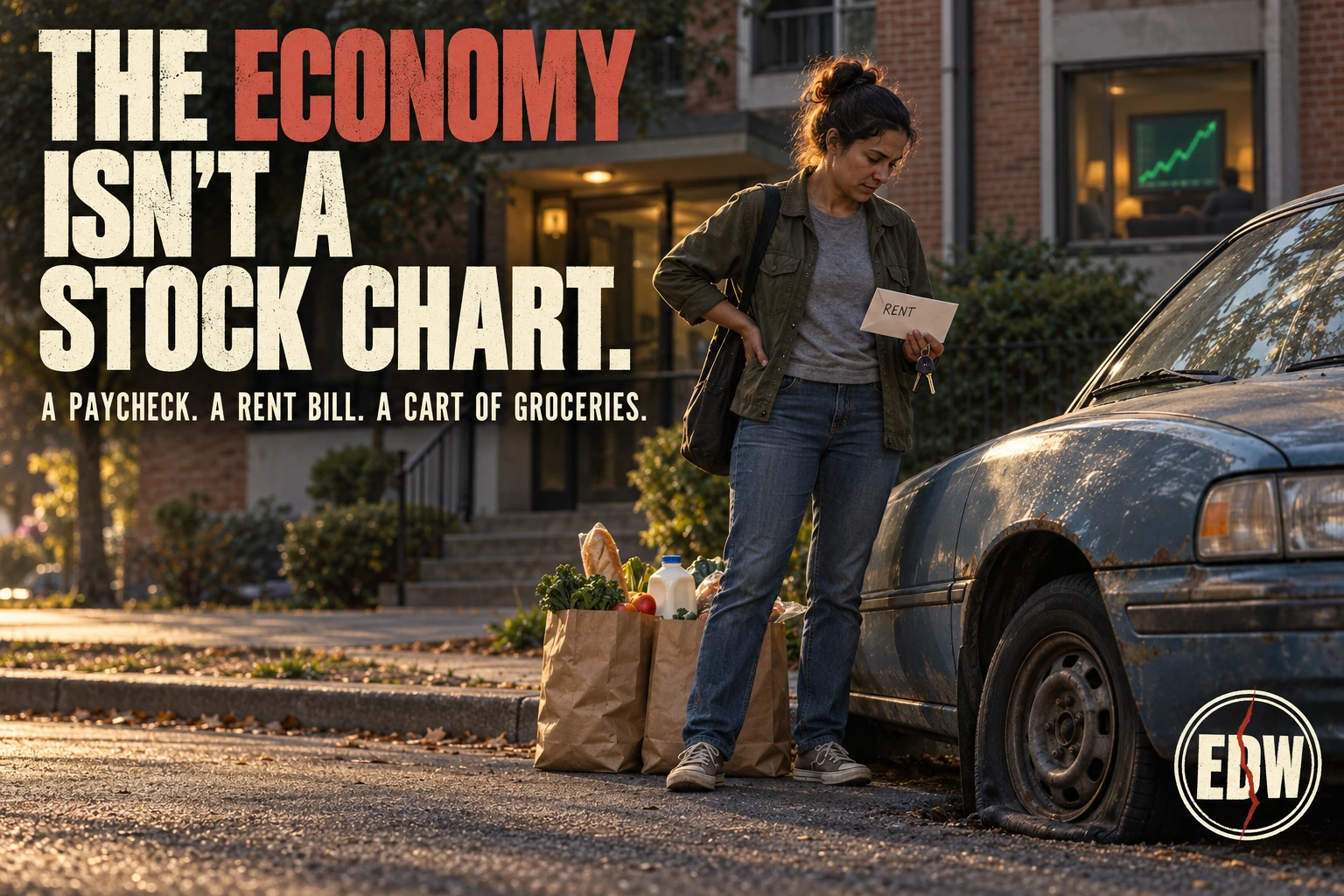
But if you’re the person stocking shelves, cleaning rooms, delivering food, caring for elders, ringing up groceries, or working a second job to cover the first job’s gaps… the stock market isn’t your economy.
Your economy is rent. Your economy is food. Your economy is whether your kid gets sick and you’re one crisis away from falling behind.
Here’s what the actual price picture looks like right now:
The Bureau of Labor Statistics says that in December 2025, overall prices were up 2.7% over the last year, but that’s not the part that punches you in the throat. Shelter (the thing you can’t skip) was up 3.2% year-over-year. Food was up 3.1%. And food away from home, the “we’re exhausted, we grabbed something quick” category, was up 4.1%.
That’s not abstract. That’s the weekly drain.
And it’s not just “feelings.” The Federal Reserve’s October 2024 national household survey (SHED) found that 60% of adults said price changes over the prior year made their finances worse. Most people aren’t “dramatic”; they’re adapting: 79% reported changing their behavior because prices kept climbing.
Now here’s the line that should stop every politician mid-speech:
Only 63% of adults said they would cover a surprise $400 expense entirely with cash or its equivalent, including a credit card paid off at the next statement. Another 13% said they could not cover it by any means.
That means millions of Americans are not living in an “economic recovery.” They’re living in a tightrope act.
And when people sneer, “Those are kid jobs,” it exposes how out of touch we’ve become. The BLS counted 80.3 million U.S. wage-and-salary workers paid hourly in 2024.
That’s not a side quest. That’s the backbone.
The Fed also found 9% of adults did short-term gig tasks, rides, deliveries, odd jobs, and many said they rely on that income to make ends meet.
So no, the “DoorDash economy” isn’t a punchline. It’s the emergency plan.
Here’s EDW’s point, straight down the middle:
If your politics can’t speak to the cost of rent, food, childcare, healthcare, and unstable wages… then your politics isn’t speaking to real life.
And if leaders keep bragging about numbers that don’t land in people’s wallets, they will keep losing the trust of the people who actually keep this country running.
A Dow point can’t pay a landlord.
A talking point can’t feed a family.
And a “strong economy” that leaves working people terrified of one broken tire is not strong. It’s fragile, and it’s angry on a delay.
If this resonates, please share it so more people stop talking past each other. And if you want more evidence-first posts like this, follow Executive Dysfunction Weekly (EDW).
EDW•