Donald Trump’s April 1 address on Iran was not a sober wartime explanation. It was an infomercial with missiles. According to the AP transcript, he bragged that Iran’s navy was essentially gone, its air force was wrecked, its leaders were mostly dead, and America was on the verge of wrapping up its objectives. Then, in the same speech, he promised another two to three weeks of hitting Iran “extremely hard” and threatened its power plants if no deal emerged and warned that its oil infrastructure could also be hit. Reuters’ read was the obvious one: a lot of swagger, no firm end date, and very little clarity about how this is supposed to conclude.
That contradiction is not a bug in the speech. It is the product. We are always one commercial break away from total victory and one mood swing away from total escalation. Iran is supposedly broken, but also still dangerous enough to justify more bombing. The mission is supposedly nearing completion, but also somehow requires fresh threats to destroy national infrastructure. It is the same trick every time: declare success, then demand more power. Mission accomplished, please stay tuned for the sequel. Reuters noted that the speech offered scant reassurance to Americans and allies and glossed over unresolved issues like Iran’s enriched uranium and the Strait of Hormuz.
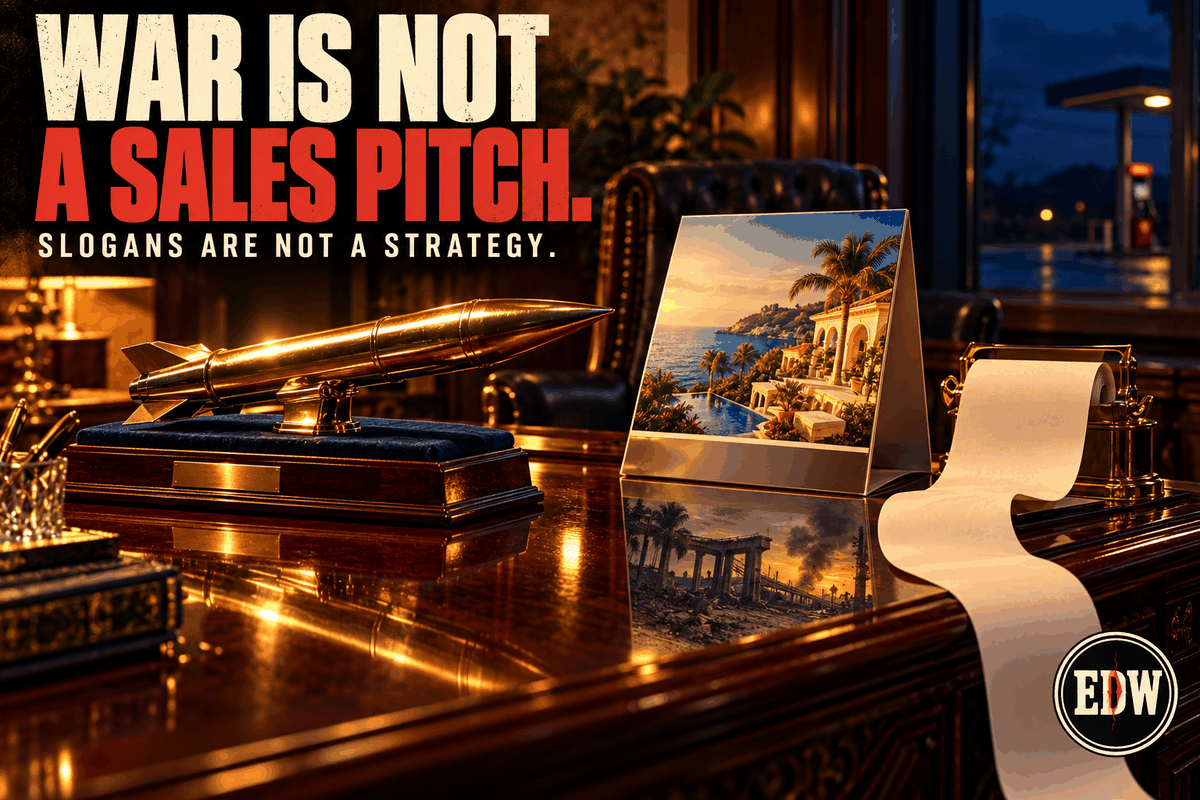
And then there is the branding, because of course there is branding. “Epic Fury.” “Midnight Hammer.” “Drill, baby, drill.” The man talks like he is naming monster trucks and limited-edition cheeseburgers. Nothing can just be policy. Everything has to sound like it was focus-grouped between pro wrestling promos and a Black Friday ad. AP’s transcript shows him moving through these labels like a man deeply convinced that if he just names reality hard enough, reality will stop asking follow-up questions.
That is what this speech was really for. Not to explain. To pre-load emotion. To make the audience feel dominance, certainty, vengeance, and confidence before anyone starts nagging about evidence, legality, duration, allied consultation, escalation risk, or whether the story changes every 72 hours. If you can make war sound like a movie title, you can delay the moment when people realize they were not given a strategy, they were given a trailer. AP reported that he offered few new details, no real strategic roadmap, and little explanation of what the promised endgame actually looks like.
The speech also leaned on the same exhausted strongman formula he always uses: flood the room with superlatives and hope nobody notices the missing paperwork. Everything is the greatest, strongest, hottest, biggest, most successful, most obliterated thing anyone has ever seen. Fine. Wonderful. Then show the receipts. AP’s fact check found that he falsely claimed there was “no inflation,” cited an unverified figure of 45,000 protester deaths in Iran, stretched credulity in claiming Iran’s new leadership is “less radical,” and repeated his old misleading line about Obama “giving” Iran $1.7 billion in cash when it was actually a settlement over money Iran had paid for undelivered military equipment decades earlier.
The energy section was especially insulting, because apparently we are all expected to stand at the pump, stare at the numbers climbing, and nod along while being told none of this really touches us. AP noted that while the United States imports only a fraction of its oil from the Persian Gulf, global turmoil still drives prices because oil is traded in a global market. Reuters then reported what happened after the speech: Brent crude surged above $109 a barrel, Asian and European stocks fell, and Wall Street futures dropped after Trump vowed to keep hitting Iran hard. So the market, rude as ever, failed to appreciate the reassuring power of adjectives.
There is also the small matter that the numbers inside the victory lap do not all line up with prior reporting. Reuters reported on March 27 that U.S. intelligence could confirm with certainty only about a third of Iran’s missile arsenal destroyed, while another third was believed damaged, destroyed, or buried, and Iran was still firing at neighbors. That does not exactly harmonize with the broad stage language of “their missiles are just about used up or beaten.” It sounds less like total annihilation and more like a White House that keeps grading its own homework in Sharpie.
What is most maddening is how familiar this performance is. Not the specific war. The tactic. The same emotional grift. The same puffed-up certainty. The same demand that everyone accept branding in place of explanation. The same bored contempt for precision. The same assumption that supporters will always be willing to buy the deluxe package, even after the last three fell apart in the driveway. Reuters reported that public patience is not exactly overflowing: in its coverage of the speech, it cited a Reuters/Ipsos poll finding 60% of Americans disapprove of U.S. military strikes against Iran and 66% want the U.S. to end its involvement quickly, even if not all its goals are achieved. AP separately reported that an AP-NORC poll found about 59% of Americans said U.S. military action in Iran had gone too far.
And that is the question hanging over this whole performance. At what point do even some of his strongest supporters get tired of being sold the same trick in a fresh wrapper. At what point does “trust me” start to sound less like leadership and more like the guy at the mall kiosk trying to straighten your hair while your wallet is already missing. How many times can you be told that contradictions are strength, that slogans are strategy, that confidence is competence, that this time the chaos is actually control.
Because this speech was not a demonstration of mastery. It was a demonstration of habit. Inflate. Brand. Threaten. Contradict. Repeat.
And some of us are very, very tired of pretending that is normal.
EDW•