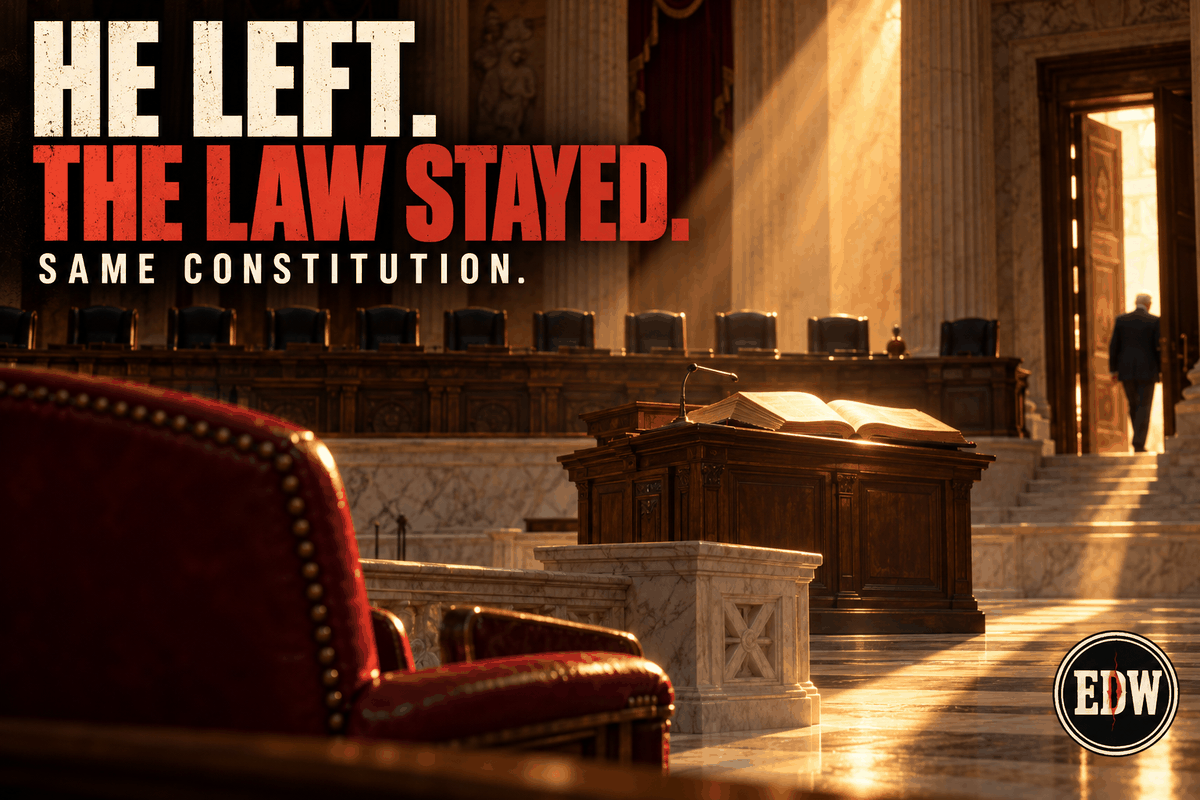
Donald Trump finally went to the Supreme Court the way he approaches most institutions: not as something independent, but as something that should be honored by his presence. On April 1, he became the first sitting president to attend oral arguments at the Court. Not a swearing-in. Not a ceremonial photo-op. Oral arguments.
So yes, it was historic. But not in the “reassuring civics textbook” way. More in the “the main character has entered the courtroom to see if reality can be bullied in person” way. Even by Trump standards, this was a fairly aggressive piece of stagecraft.
And then came the most perfectly Trumpian detail of all: he did not stay. So the president of the United States made history by attending oral arguments on one of the most constitutionally reckless executive orders of his second term, sat for his own side, and then bailed early in the challengers’ argument. Front-row seat for the monologue, sudden scheduling conflict for the counterargument.
Trump departed shortly after Cecillia Wang of the ACLU began arguing for the challengers. The official transcript shows Wang opening with the basic American rule that birthright citizenship applies to nearly everyone born here, and arguing that the Fourteenth Amendment put that rule “out of the reach of any government official to destroy.” The first justice to question her was Clarence Thomas, who asked what unifying legal principle connected the accepted exceptions to citizenship. So, based on the public record, Trump stayed for Sauer trying to sell executive branch fan fiction, then left early in Wang’s defense of birthright citizenship.
Which, honestly, is almost too on the nose. He came to the Court for the part where the government says the Fourteenth Amendment should be read like a Terms of Service update. He left around the part where the other side said, in substance, no, you do not get to rewrite the Constitution because Stephen Miller found a thesaurus and a grievance. If satire were not already dead from overwork, this would have finished it off.
And let us be very clear about the broader context, because this is not some poor persecuted president finally confronting a hostile judiciary. Reuters noted that this Court has often sided with Trump since his return to office, including allowing his administration to end humanitarian protections for migrants, deport people to countries where they have no ties, and carry out aggressive immigration raids while legal challenges continue. This is not a Court that has spent the year roughing him up in an alley. This is a Court that has very often handed him the keys and said, carefully now.
Which is what makes Wednesday so interesting. Even this Court sounded reluctant to let him bulldoze birthright citizenship by executive order. Reuters reported that the justices, including members of the conservative majority and three Trump appointees, appeared largely skeptical. Chief Justice John Roberts called the administration’s supporting examples “very quirky,” and when Solicitor General Sauer argued that modern conditions had changed the stakes, Roberts gave the kind of sentence that should be mounted on the wall of every law school classroom: “It’s the same Constitution.” That is as close as John Roberts gets to saying, stop trying to sell me a rebrand of text that already exists in English.
We do not know why he left. But the optics were unmistakable. And maybe that is why Trump left. Not because one justice said one magic thing and the marble cracked. Not because the Court suddenly found a spine in a dramatic violin swell. But because the vibe in the room was wrong for him. The room was no longer arranged around his will. The questions were no longer flattering his premise. The institution he imagines as part trophy case, part enforcement arm had the nerve to behave like an institution. Exhausting, really.
There is also a more revealing angle here. Trump has been openly furious at justices who fail the loyalty test in his head. After the Court’s February 20 ruling striking down much of his sweeping tariff regime, he attacked the justices who sided against him, especially Neil Gorsuch and Amy Coney Barrett. The tariffs ruling was 6-3, written by Roberts, and held that Trump exceeded his authority under the emergency-powers law he invoked. In other words, he walked into the Supreme Court this week not as a man with a spotless run of judicial adoration, but as a president already seething that judges he appointed had mistaken themselves for judges.
So picture the posture. He shows up in person for an unprecedented first. He sits in front as the government argues that the Citizenship Clause does not mean what generations of Americans, courts, statutes, and common sense have understood it to mean. He hears skeptical questions. He hears that the same Constitution still applies. He hears the opposing lawyer begin to explain that this rule was put beyond the reach of “any government official.” And then, somehow, he is no longer needed in the room.
That is the whole presidency in miniature.
He loves courts when they act like back-office staff. He loves judges when they act like appointees instead of constitutional officers. He loves legal language when it can be twisted into a weapon. But the second a forum starts behaving like a forum, the second an opposing argument actually gets oxygen, the second the law stops being a prop and starts talking back, the man who never shuts up finds somewhere else to be.
And here is the question his strongest supporters should eventually have to ask themselves, if only out of self-respect. At what point does this routine get old. At what point do you notice that the “fighter” keeps demanding institutions bow to him, then sulking when they do not. At what point does “he tells it like it is” collide with the simpler truth that he mostly wants to hear one side of every argument, preferably his, preferably uninterrupted, preferably from a seat he considers his by birthright.
The irony is almost vulgar. He went to the Supreme Court to watch his administration argue against birthright citizenship. And then he left before the strongest argument for constitutional birthright citizenship had even finished clearing the air.
Historic first, yes.
Also a perfect exit line.
EDW•