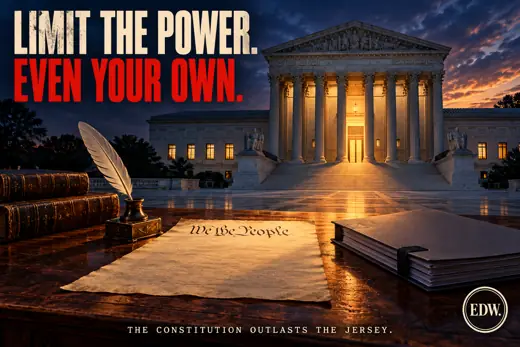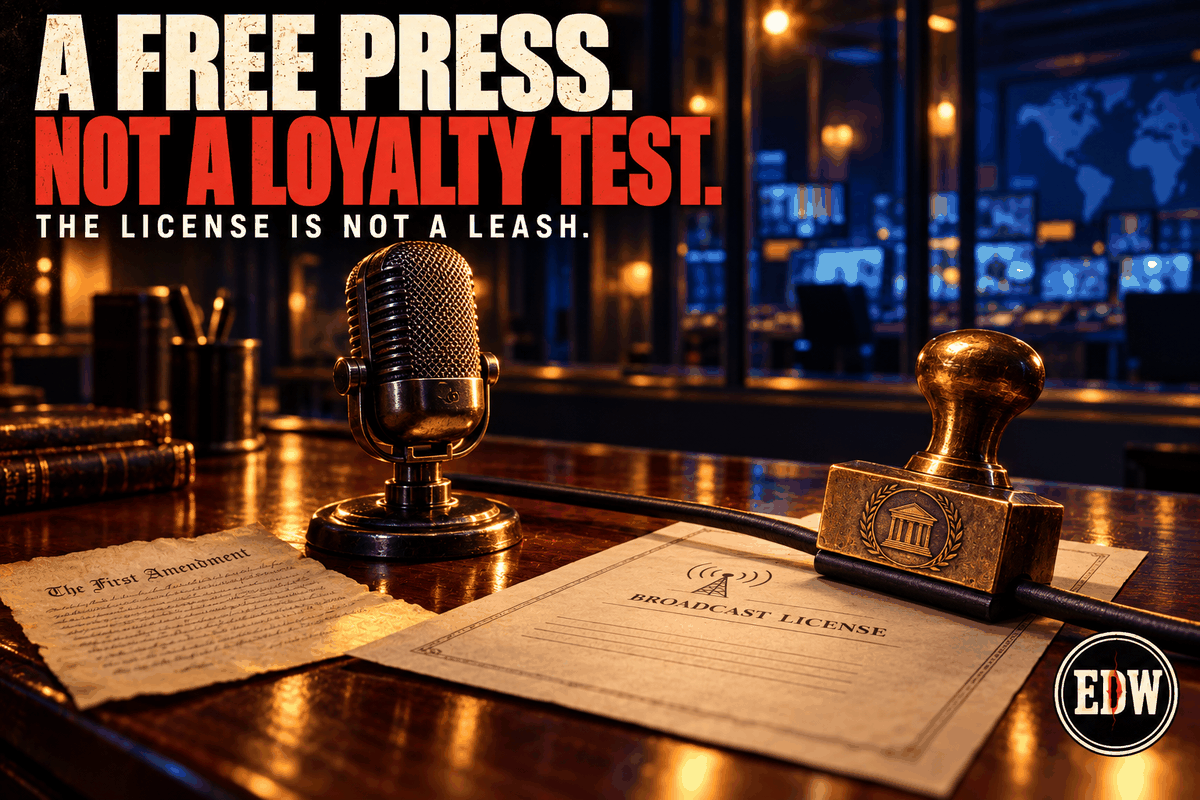
The First Amendment is short for a reason. It does not say, “Congress shall make no law unless the government is annoyed.” It does not say, “unless we are at war.” It does not say, “unless a regulator thinks your coverage is a hoax.”
It says what it says. And it was written by people who had already seen what happens when power gets to decide what speech is “acceptable.”
Here’s why this matters right now.
The receipts, in plain English
In this Trump term, the FCC under Chair Brendan Carr has repeatedly treated the broadcast license as leverage over speech. Not one moment. A pattern.
• July 2025: The FCC approved Paramount–Skydance license transfers after Skydance committed to fair, unbiased, fact-based CBS reporting and an ombudsman for at least two years.
• Sept 2025: The Jimmy Kimmel episode. Reuters reported Carr pushed Disney/ABC to act, “easy way or the hard way,” then later said government pressure played no role and blamed ratings. Carr defended his position in September 25 letters to senators.
• Nov 2025: Former FCC leaders petitioned to repeal the “news distortion” policy, arguing it chills speech and can be weaponized. They pointed directly at this new posture.
• Jan–Feb 2026: The “equal time” squeeze. January 21 FCC guidance questioned blanket “bona fide news” exemptions for entertainment talk-show interviews with candidates. The View faced an investigation, and a February Colbert interview prompted a dispute over compliance. CBS denied barring the interview and said it had provided legal guidance.
• Feb 2026: Carr launched the voluntary “Pledge America Campaign,” encouraging “patriotic, pro-America” programming for the country’s 250th anniversary and connecting participation to broadcasters’ public-interest obligations.
• Mar 2026: Escalation during the Iran war. Carr warned broadcasters to “correct course” on “news distortions” or risk license consequences. Coverage emphasized the FCC’s leverage is over local broadcast licenses, not cable or streaming.
That is not neutral enforcement. That is speech pressure, pointed at specific kinds of speech.
Why the Founders would recognize this instantly
The Founders did not imagine a perfect press. They imagined a necessary press.
James Madison warned in his January 1800 Report on the Virginia Resolutions that unconstitutional power over the press should produce “universal alarm,” because the press is the practical guardian of other rights. He was writing with the Sedition Act in mind, but the logic is timeless. If the state can punish criticism, it can eventually punish anything.
Jefferson was even blunter. He argued that keeping public opinion informed is the first job of a free system. His point was not that journalists are saints. In today’s terms: government without scrutiny rots.
Hamilton, in Federalist 84, argued against adding a bill of rights, fearing that limits on an ungranted power could furnish a pretext for claiming it. He also warned that definitions of press liberty leave room for evasion.
That is the core civics lesson. The First Amendment is not a courtesy to reporters. It is a safety mechanism for everyone else.
What “public interest” is being turned into
Yes, broadcast licenses are different. Spectrum is public. The FCC has technical authority. Renewals exist. The statute says “public interest.”
But “public interest” cannot become “publicly agreeable to the administration.”
The moment a regulator signals that disfavored coverage might trigger license pain, you do not need formal censorship. You get self-censorship.
Lawyers kill segments. Producers soften questions. Local affiliates ask if a story is worth the risk. Newsrooms begin to behave like people who might get audited for the wrong tone.
That is how pressure can win. Not in court. Before court.
And it is especially dangerous during war, when governments are most tempted to treat scrutiny as sabotage. That is why the Founders protected the press in the first place.
The real test is simple
If this was only about technical compliance, you would not see the same themes repeating in public messaging:
• “news distortion”
• “correct course”
• “patriotic” programming
• pressure around talk shows and political interviews
• Carr’s argument that licenses are not property rights, paired with his suggestion that broadcasters unwilling to serve the public interest could surrender their licenses and stream instead.
That is not regulation. That is narrative management.
What EDW thinks the standard should be
The FCC can regulate spectrum. It can enforce real, narrow rules tied to concrete harms. It cannot posture as the national referee of truth. It cannot treat a broadcast license like a loyalty leash.
If there is actual, provable misconduct, follow the real process. Require evidence. Apply neutral standards. Do not pick targets by viewpoint. Do not use vague language that chills lawful journalism.
Because if you cheer this when it hits “their” network, you are writing the playbook for it to hit “yours” next.
Madison’s warning was not “be careful when the other party is in power.” It was “universal alarm.”
We should act like we understand what that means.
EDW•