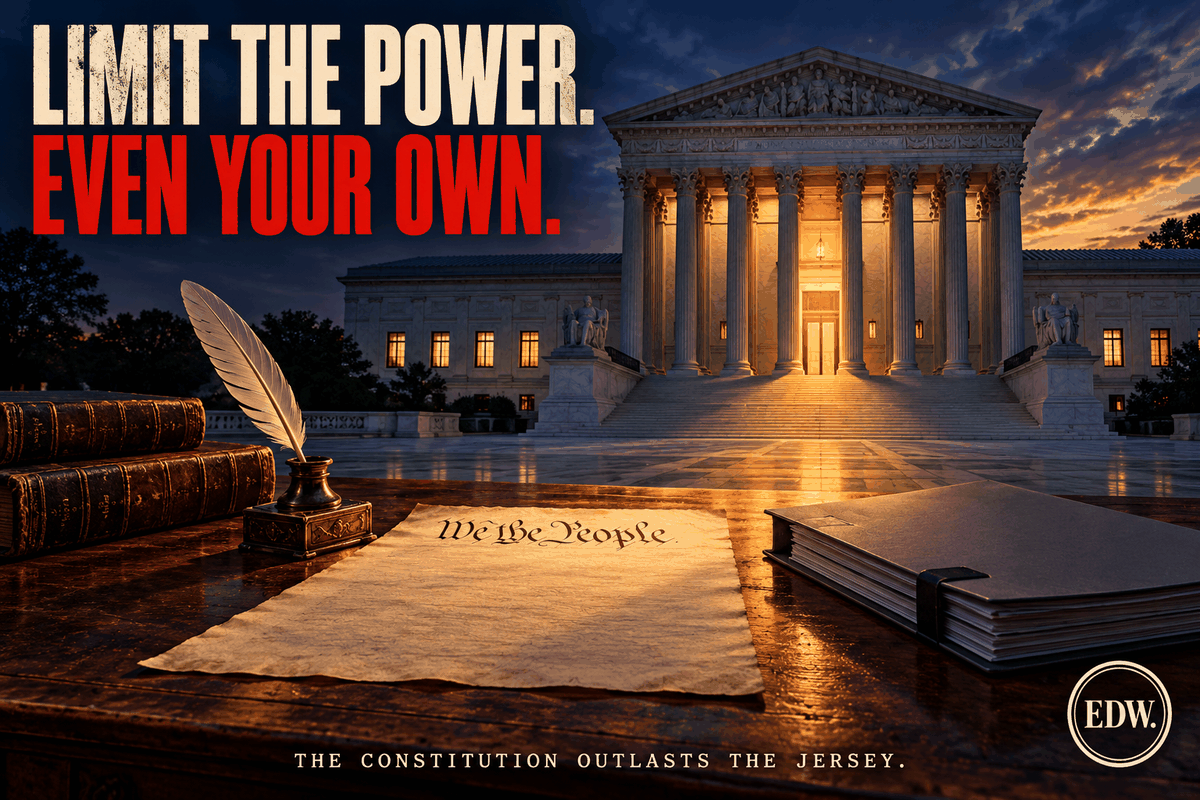
A 6–3 Supreme Court decision striking down a broad tariff program under IEEPA is not, at its core, a trade story. It is a constitutional story. It is the oldest American argument, the one we keep forgetting and then relearning the hard way: who gets to decide.
Right now, I’m focusing on Justice Neil Gorsuch’s separate writing because it does what so few leaders are willing to do in public anymore. It drags us back to first principles. It treats the Founders like they were serious people who built a serious system on purpose, not props in a partisan skit.
Here’s the principle that matters.
Tariffs are not vibes. They are not messaging. They are not a “strongman lever.” Tariffs are taxes by another name, and taxes are power. The Constitution did not hide that power inside the Oval Office. It placed it in Congress, the branch closest to voters, the branch designed to argue in daylight, the branch that has to own the consequences.
That design wasn’t an accident. It was the whole point of the republic.
The Founders were allergic to concentrated authority. Madison’s warning is blunt enough to tattoo on the walls of every federal building: the accumulation of legislative, executive, and judicial power in the same hands is the definition of tyranny. They built a machine that forces friction. They wanted ambition to counteract ambition, because they didn’t trust angels to run governments, and they didn’t trust any one person to hold a nation’s economy by the throat.
So when Gorsuch leans into that architecture, when he emphasizes that the President executes the law, but does not get to become the law, he’s not being academic. He’s being American.
And it matters who is saying it.
Gorsuch was appointed by Trump. Amy Coney Barrett, who also joined the majority, was appointed by Trump. Brett Kavanaugh, another Trump appointee, dissented. If the story you’ve been fed is that constitutional limits are just a “resistance” talking point, this ruling (and especially a Trump-appointed justice grounding it in the Founders’ framework) punctures that cartoon. It reminds us what a functioning system looks like: judges disagreeing, yes, but arguing from structure, text, and the separation of powers, not from tribal loyalty.
This is where EDW draws a hard line.
You can be hawkish on China. You can want to bring manufacturing home. You can believe tariffs are sometimes smart policy.
None of that answers the real question: who decides?
Because the danger isn’t “tariffs.” The danger is the precedent that a President can reach for an enormous, economy-warping switch, one that hits every household through higher prices, and justify it through a broad reading of an old statute, a declared emergency, or a convenient theory of executive discretion.
That’s how a republic becomes a permission slip.
That’s also why the “but this guy did a bad thing before” tactic never works as an exoneration in any other context, because it’s a bait-and-switch away from the actual event. You don’t get to excuse an institutional power-grab by pointing at someone’s personality, someone’s past, or someone’s politics. The question stays the same: does the Constitution allow this branch to do this thing?
If Gorsuch is doing what his concurrence is being described as doing, anchoring the analysis in the Founders’ allocation of power, then he is correct in the way that matters most right now: he is defending the method that keeps us free, even when we’re furious about the outcome.
And if you’re an independent voter, here’s the part you should not ignore.
A country cannot survive on “our guy gets to do it because your guy did it.” That is not law. That is not order. That is just rotating permission to abuse the same tool until the tool owns us.
So what now?
If Congress believes broad tariffs are necessary, Congress can pass them. Publicly. Specifically. With clear limits, clear triggers, and clear accountability. If we’re going to pay the bill at the grocery store, our representatives should have to sign their names to the decision that raised it. Not outsource it to a single person and call it strength.
That’s not anti-Trump. That’s not anti-Democrat. That’s pro–constitutional republic.
And when a Trump-appointed justice points back to the Founders and effectively says, “No, this power doesn’t live there,” the grown-up response is not to boo or cheer based on the jersey. It’s to recognize a rare thing in American life right now:
A public official doing the job as designed, limiting power even when it’s inconvenient.
EDW•