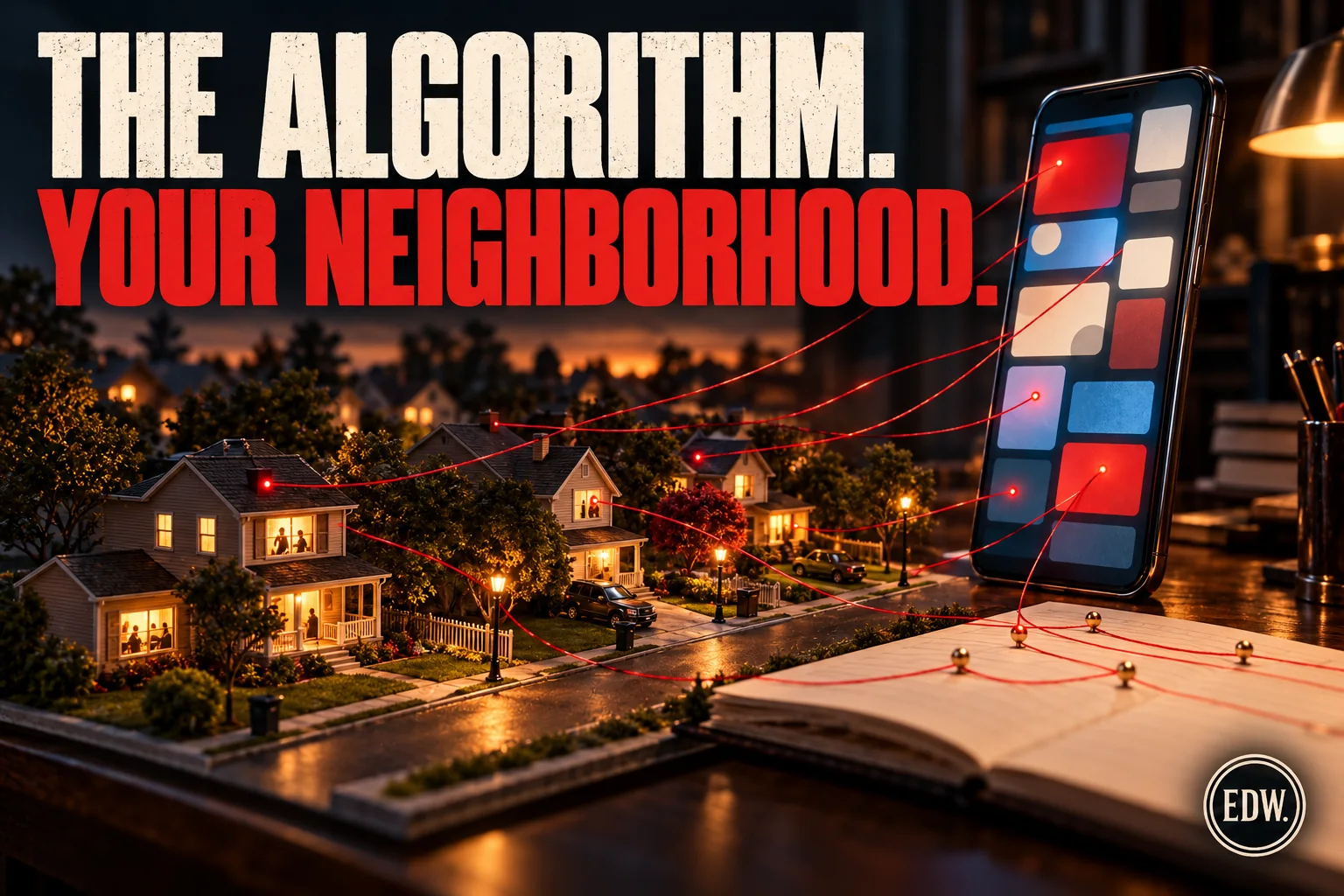
(yes, this is an ADHD powered connect the dots rant with receipts)
Let’s string the pearls:
Pearl 1 The starter home is now a line item.
In the first quarter of 2025, investors bought about 1 in 5 homes sold across the 39 major metro areas Redfin studied; in the cheapest tier (the very houses your kids try to buy), they bought roughly 1 in 4. That category includes smaller business buyers as well as institutions. Lower purchase prices can make those homes attractive to investors.
“Wall Street owns every house” isn’t true nationally; big landlords hold ~2–3% of single‑family rentals overall, but averages lie. As of June 2022, large institutional investors owned about 25% of single-family rental homes in Atlanta, 21% in Jacksonville, and 18% in Charlotte. Corporate concentration can shape a neighborhood. If you’re losing to a spreadsheet, that’s why.
Short‑term rentals then squeeze the remaining oxygen. Peer‑reviewed research finds Airbnb increases both rents and prices, especially where owner‑occupancy is low. New York City’s registration crackdown (Local Law 18) vaporized most illegal listings virtually overnight, proof the conversion pressure was real.
Pearl 2: The “local” in local news is on a diet.
Your last trusted venue used to be the 6 p.m. local. Now, the biggest station groups are…big. Nexstar calls itself the largest local television broadcaster. Its 2024 annual report listed 201 full-power stations as of February 27, 2025, with about 39% national reach for owned stations after the FCC’s UHF discount, and about 70% for its own and partner stations without that discount. The discount counts half the television households in a UHF station’s market toward the national cap.
Sinclair runs ~185 stations in ~85 markets and is actively trying to get bigger (its fresh bid for E.W. Scripps would mash up 240+ outlets). Consolidation isn’t a theory; it’s a press release.
What changes when a chain rolls in? Multiple studies find acquired stations cut local political coverage and pivot toward national talking points; one landmark analysis shows a ~25% jump in national politics after Sinclair buys a station, alongside a rightward slant in tone. You also get more centrally produced “must‑run” segments (remember that 2018 montage where anchors across America read the same script?). Trust me, your brain noticed, even if you didn’t clock why the A‑block felt…pre‑baked.
Regulators are loosening bolts, not tightening them: a federal court just vacated the FCC’s “Top‑Four” ban (owning two of the top four stations in a market), and the FCC is reviewing the 39% national cap. Translation: more combos are now easier, and the ceiling might go higher.
Pearl 3: The feed is designed to make you mad (and keep you there).
Platforms optimized for engagement (hello, 2018 “meaningful social interactions”) reward posts that spike reactions, especially anger. The Haugen docs and follow‑ups aren’t subtle about this. Meanwhile, a study of Twitter from 2006 through 2017 found false news spread farther, faster, and deeper than truth, with especially pronounced differences for political news. Bots accelerated true and false news similarly; human sharing helped explain the gap.
Add in the fact that smartphone‑based eye‑tracking is now feasible, and you see the direction of travel: the machine can test what makes your gaze pause and shape the next hit. That is a potential extension of surveillance capitalism: your attention is raw material; prediction is the product.
Pearl 4: Money floods the pipes that carry the message.
“Dark money” in the 2024 cycle hit a record ~$1.9B. Separately, online political advertising totaled at least $1.9B. Those measures overlap and must not be added together. Local TV and Connected TV basked in record cycles, too. The business model for polarization is…profitable.
Connect the dots (the short version)
• Homes get financialized → starter stock shrinks → rents climb → families pushed from buying to bidding wars → resentment grows.
• Local news gets centralized → fewer community‑specific facts, more national, prefabricated conflict → resentment gets a nightly script.
• Feeds weaponize attention → anger outruns accuracy → our resentment is now a growth KPI.
• Money buys more of the above → rinse, repeat, escalate.
If it feels like the same handful of interests can predict you, rent to you, and talk at you, that’s because the incentives now rhyme.
“OK, EDW, where’s the off‑ramp?”
We’re not here to tell you what to do. We’re here to give you questions that good neighbors ask and bad actors hate:
1. Who owns this? Your rental? Your “local” station? Your data? If you can’t see the beneficial owner, assume mischief until proven otherwise. (GAO says metro‑level concentration is the ballgame.)
2. Where’s the process? Is policy arriving as a post, or as a rule you can read? (Paper beats performative every time.)
3. What’s the metric? If the claim can’t clear a link + number test, it’s content, not truth. (Anger is not a source.)
4. Is the “local” actually local? If your 6 p.m. newscast sounds like a national pundit with a weather hit, it’s consolidation talking.
Guardrails that work (no silver bullets, just boring fixes)
• Homes first, then hotels: primary‑residence short‑term rentals with hard caps, platform accountability, and enforcement that actually bites; NYC proved behavior changes when rules do.
• People before portfolios: phase down large‑fund ownership of single‑family over time with taxes that nudge sell‑backs to occupants; protect tenants during the handoff; keep carve‑outs only for newly built build‑to‑rent stock that adds supply. (Such proposals would require careful legal design, tenant protections, and review of property-rights constraints.)
• Local news with local bones: restore/defend ownership caps and require must‑run transparency (“who ordered this segment?”). The court just widened consolidation lanes; policy can narrow them again.
• Sunlight on spend: real‑time super‑PAC and nonprofit donor disclosure above de‑minimis thresholds; platform ad archives by district and creative (Brennan/OpenSecrets show why).
• Align algorithms with people: independent audits of engagement‑ranking harms (outrage, copycat risk); friction for forward‑without‑reading; downrank repeat falsehoods (the Science paper is your baseline).
The EDW read
If you feel nuts trying to follow all this, that’s not ADHD; that’s design.
Financialization turns homes into yield. Consolidation turns cities into content markets. Algorithms turn neighbors into segments. Dark money turns segments into weapons.
The fix isn’t a new team; it’s new guardrails. Homes for humans. News with local spine. Platforms that optimize for truth over tantrums. And receipts you can actually click.
We’ll keep bringing them.
Executive Dysfunction Weekly
Receipts: Redfin on investor share & entry‑level targeting; GAO on SFR concentration; Airbnb’s price‑and‑rent effects; NYC Local Law 18 outcomes; Nexstar footprint & FCC cap/UHF; Sinclair size, “must‑runs,” and the research on nationalization/rightward shift; Top‑Four ban vacated; dark‑money and online political ad spend; Haugen/MSI and the “anger boost”; false‐news diffusion; surveillance capitalism and smartphone eye‑tracking.
P.S. If you want the snarky bumper sticker: “Neighbors, not portfolios. News, not scripts.”
EDW•