An extremely rigorous investigation conducted from my couch
Abstract (the part that makes this sound serious):
After minutes of meticulous research (scrolling, sighing, and briefly staring into the middle distance), I have concluded that people are not getting dumber. They only appear dumber because the internet has industrialized the production and distribution of confident nonsense. Intelligence is fine; signal is not. Thank you for coming to my TED‑thread.
Methodology
• Sample: Everyone I’ve ever met plus a statistically significant number of strangers yelling in the comments.
• Measures: Number of times a false claim is repeated with the phrase “Do your own research.”
• Instruments: One phone, twelve tabs, and a coffee that went cold while I fact‑checked a meme.
• Control group: Books. Silent, dusty books that don’t auto‑play a video promising “SHOCKING TRUTH THE MEDIA WON’T TELL YOU.”
Results (What I discovered while avoiding real work)
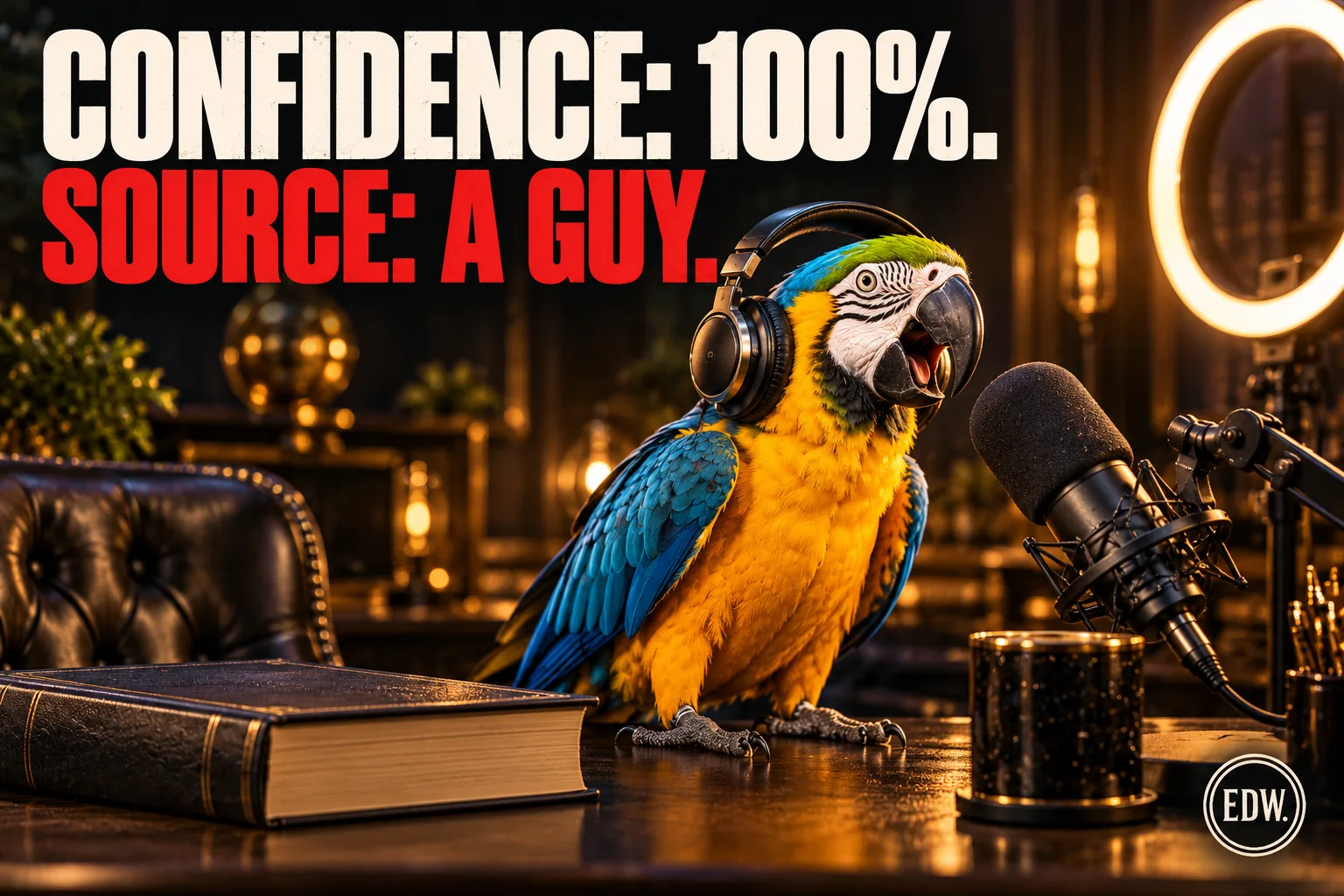
1. The Parrot Problem:
The internet turned repetition into a superpower. If a sentence can be said loudly, confidently, and with an image of a bald eagle, it will be repeated until it sounds true. (See also: “I’m not saying it’s aliens, but it’s aliens.”)
2. The Algorithm Loves Drama, Not Accuracy:
Imagine a librarian shelving books by how furious they make you. That’s your feed. The more eyebrows an idea scorches off, the more oxygen it gets. Facts tend to whisper; outrage brings a bullhorn.
3. Confidence Inflation:
Everyone now speaks in Thread Voice, a firm, declarative tone that suggests a peer‑reviewed thunderbolt from Mount Science. The underlying source is often someone’s cousin’s podcast filmed in a parked car. The car is a Jeep; the conclusions are not.
4. The Disappearing “According to…”
Remember when claims wore little name tags like “according to the National Academy of Something?” Now it’s “Sources? Bro, open your eyes.” Meanwhile, actual sources are home, uninvited, eating stale pretzels and wondering what they did wrong.
5. Long Division vs. Long Con:
It’s not that people can’t think; it’s that the cost of thinking exceeds the dopamine yield of hitting “share.” We’re not cognitively bankrupt; we’re time‑poor and adrenaline‑rich.
6. The Mandela Effect As a Service:
The internet can convince large populations they recall a universe where the cartoon bear family spelled their name differently. (They didn’t.) Memory is a suggestion; the web made it a group project.
Discussion (Where I pretend to be a professor)
Look, brains haven’t melted. If you ask someone to assemble a grill, reset a router, or file taxes in a leap year, they’ll rally. But in the information jungle, where facts and fakes wear the same camouflage, performance looks worse because the environment is rigged.
We’ve swapped “Is it true?” for “Is it trending?”
Truth used to travel by footnote. Now it commutes by For You Page, carpooling with ragebait and miracle cures. The problem isn’t raw intelligence; it’s that our epistemic immune systems are being stress‑tested by content engineered to slip past our defenses: cute, punchy, emotionally hot, and just plausible enough to nod along to while microwaving leftovers.
Then there’s cognitive outsourcing: once you can look up anything, you stop storing everything. That’s not stupidity; that’s sensible resource management. But it makes us vulnerable to whoever answers first, especially if they arrive with caps lock and a ring light.
Case Studies (100% anecdotal, 200% accurate)
• The “Study” That Isn’t:
A post cites “Harvard” (no department, journal, author, just vibes). It spreads like glitter. Two days later, a correction arrives. It gets eight likes and a polite yawn.
• The Myth with a Map:
Someone overlays arrows, circles, and heat‑map colors on a satellite image. Congratulations, your amygdala has been hijacked by PowerPoint.
• The “Just Asking Questions” Gauntlet:
A thread launches with nine loaded questions and zero responsibilities. Replies demand answers, then more questions, until you’re debating gravity with someone named CryptoSpartan.
Limitations (My least favorite section, now with honesty)
• I did not double‑blind anything except my trust.
• I did not preregister this rant. (Shocking.)
• I cannot rule out seasonal effects such as “It’s Tuesday.”
So what actually works? (Yes, even in sarcasm we do solutions.)
Three‑Step Anti‑Bunk Filter
1. Who says? If it’s “a guy,” keep walking. If it’s a study, what journal? If it’s a journalist, what outlet? If it’s a screenshot of text over a blurry sunset, throw it into the sea.
2. How do they know? Look for methods, not memes. Numbers need context; charts need axes; anecdotes need friends.
3. Who disagrees, and why? Check the strength of the evidence and whether relevant experts agree. A strong consensus does not require an equally credible opposing camp.
Practical Habits
• Read past the headline. Your thumbs will protest. Be strong.
• Reverse‑image search anything viral that looks too cinematic to be true. (Because it is, and it’s from 2013.)
• Delay the share. Ten minutes of cooling saves ten hours of untagging yourself later.
• Find a few “house experts.” That one epidemiologist who writes like a human; that data journalist who shows their work; that librarian who drinks tea and crushes misinformation like a piñata.
Frequently Asked Feelings
Q: Are we doomed?
A: Only if we confuse the loudest with the truest. The internet is a megaphone factory; bring your filters.
Q: Isn’t this elitist?
A: No. It’s pro‑plumbing. Truth is infrastructure. You notice it when it breaks.
Q: What about free speech?
A: Speech is free; verification is work. We need more of the second so the first doesn’t drown us in glitter.
Conclusion (the part you can screenshot)
People aren’t dumber. They’re just performing intelligence on a stage where the spotlight operator is an algorithm that gets paid by the gasp. If you give smart people bad information at high speed with applause for overconfidence, they will look less smart, right up until they stop, ask three questions, and ruin a perfectly good rumor.
So no, we didn’t torch the gene pool. We just gave every parrot a podcast. And until we collectively rediscover the ancient arts of citing, checking, and occasionally saying “I don’t know,” the smartest people you know will keep losing arguments to a jpeg.
(This has been a peer‑unreviewed publication from the Journal of Things I Yelled Into a Pillow. Corrections welcome, citations adored, memes quarantined.)
EDW•