I recently stopped by my local bank to deposit some leftover yen from my trip to Japan. The teller, friendly and curious, asked me what I remembered most vividly from the trip. It got me thinking and sharing, because what I remembered most wasn’t the stunning scenery or amazing food (though they were fantastic).
It was something deeper, something that hurt to admit: what I saw in Japan made me question how much unnecessary strain we accept at home.
Japan is cleaner, incredibly so. Streets, public transit, parks: everything gleams. But the real difference isn’t just about cleanliness.
It’s about character.
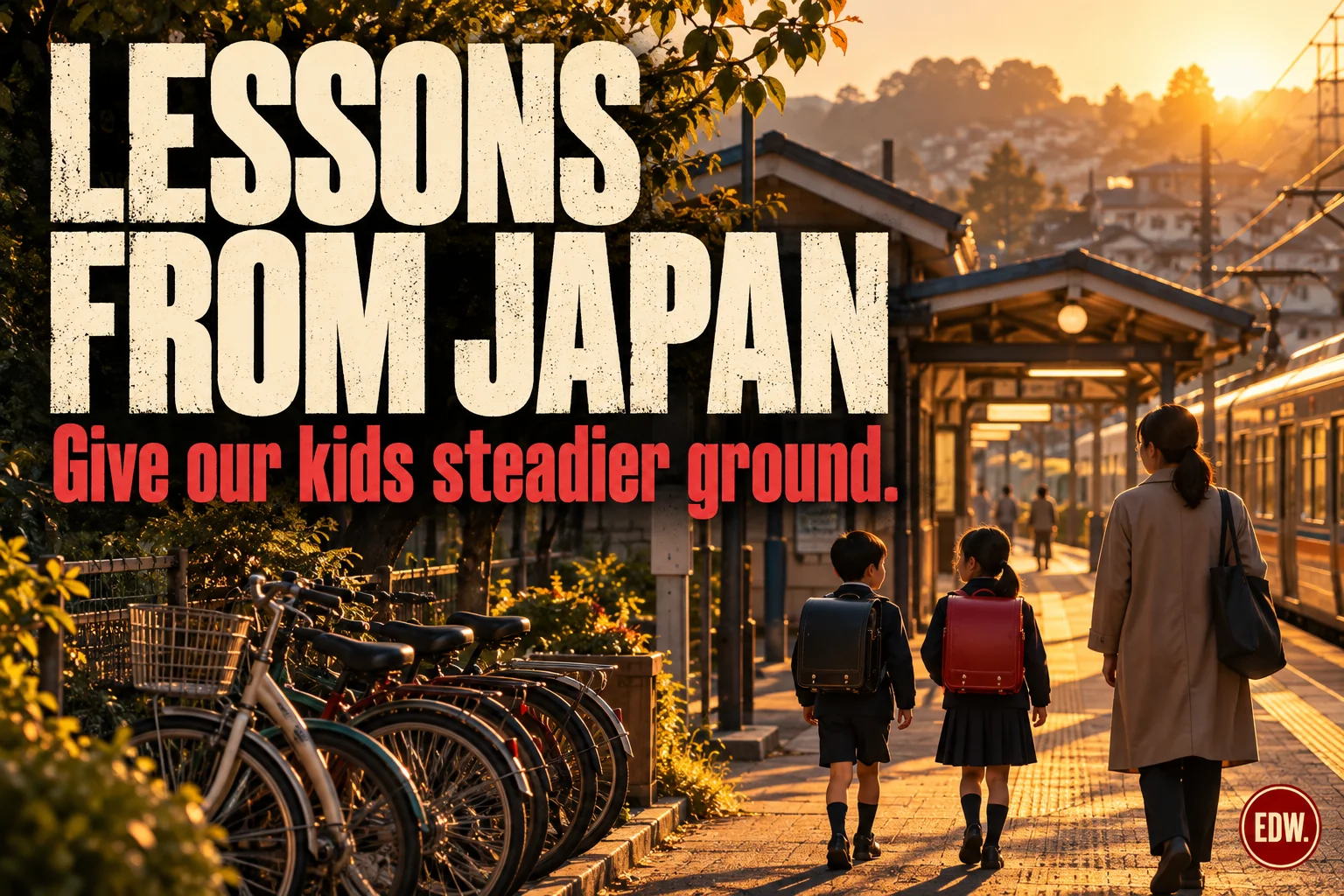
At train stations, I saw fields of bicycles, some of them expensive-looking, sitting without any locks I could see. That stayed with me. I didn’t witness theft or damage, but a visitor’s impression cannot tell us how often either happens. Japan’s own police record bicycle theft. What struck me was the sense of trust I felt in those places.
It made me wonder what it takes to build that kind of trust where we live.
The children I noticed in Tokyo made an even stronger impression. Young kids in neat uniforms seemed confident navigating public transit and stepping into their days. But I couldn’t know their ages, their worries, or what support was just out of sight. I went too far in turning that impression into a claim that Japanese children aren’t anxious. UNICEF’s May 2025 report ranked Japan 32nd on its child mental-health dimension, even while ranking it first in physical health. Japan’s education ministry had also reported serious problems with school nonattendance, bullying, and anxiety. Those children’s struggles count, too.
For nearly eight years, I sat at the front desk of a child care center at a community college campus in rural southeastern Washington. I spoke with hundreds of families. Every morning, parents shared their struggles, frustrations, and love for their children. But beneath those conversations was an unsettling truth: our kids are burdened by stress, anxiety, and uncertainty because we as a society are failing them. We make simple tasks too complicated.
Basic stability too elusive.
The trip left me asking why healthcare, education, and housing have to feel so precarious for so many families here. I can’t claim Japanese families never worry about those things. But the struggles I heard at that child care center were real, and we owe our children more stability than we’re giving them.
The need for change is stark.
Go to a wealthy community, and you’ll likely see less anxiety, fewer struggles, better-equipped schools, and more confident kids.
It’s not magic; it’s money. It’s a level playing field.
The heart of our problem is income inequality and how property taxes fund our schools. Every generation we allow this inequity to persist deepens the divide between classes. We need to do better: not socialism, but genuine fairness. We can learn from other countries without pretending any of them has solved every family’s struggle. My trip to Japan gave me reasons to ask harder questions about what we accept here.
Why do our leaders distract us with manufactured outrage? Why the endless labeling of neighbors as radical leftists or communists? Because those in power know that the second we stop fighting each other, we’ll recognize how badly we’re all being squeezed.
Working-class America is being crushed. And the consequences show up most painfully in our children.
We often say, “It’s for the children,” but our actions suggest otherwise. Unless the child is born wealthy, we as a society don’t seem to care enough. Japan showed me it doesn’t have to be this way. We can and must do better for our kids, our neighbors, and ourselves. It’s time to start asking hard questions, demanding real solutions, and putting our children’s future ahead of divisive political rhetoric.
EDW•