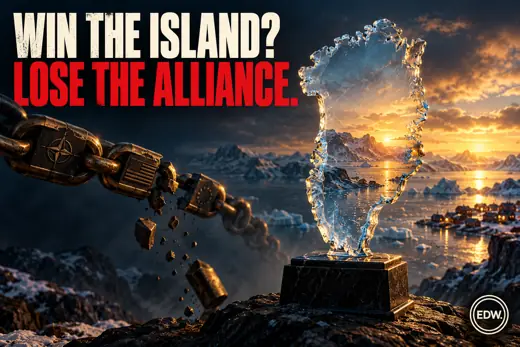
A functioning constitutional republic can disagree about policy. It can argue over trade, borders, budgets, and war. What it cannot normalize is this: the President of the United States treating peace like a personal reward, something he is obligated to pursue only if he receives enough applause.
On January 18, 2026, Norway’s prime minister, Jonas Gahr Støre, reached out to President Trump on behalf of himself and Finland’s president, Alexander Stubb. The message was not provocative. It was diplomatic. It was an appeal for de‑escalation amid multiple crises (Greenland, Gaza, Ukraine, and a tariff announcement), plus a request for a call “to take this down and de‑escalate.”
Here is the posture of allied leadership in a tense moment: reduce temperature, keep lines open, prevent spiral.
The President’s response, confirmed by Norway’s prime minister and reported by Reuters, is the part that should stop every American (left, right, and exhausted middle) cold.
“I no longer feel an obligation to think purely of Peace, although it will always be predominant…”
That passage is not an internet rumor. Norway’s prime minister confirmed receiving the message, which was reported publicly.
It is followed by a demand that is even more destabilizing:
• Trump says Denmark cannot protect Greenland from Russia or China.
• He questions Denmark’s “right of ownership.”
• He asserts NATO “should do something for the United States.”
• He concludes that “The World is not secure unless we have Complete and Total Control of Greenland.”
Let’s be relentlessly clear about the factual terrain beneath this.
Greenland is a self‑governing territory within the Kingdom of Denmark, a NATO ally.
The Nobel Peace Prize is not awarded by Norway’s government. It is awarded by the Norwegian Nobel Committee, an independent body appointed by Norway’s parliament.
So when the President writes to Norway’s prime minister, “your Country decided not to give me the Nobel Peace Prize,” he is either misunderstanding basic governance or deliberately collapsing it for rhetorical effect.
Neither is acceptable. Incompetence and manipulation both corrode statecraft.
Now the point of this op‑ed is not to litigate who “deserved” a Nobel Prize. The Nobel committee owes no politician anything. The deeper issue is what I read as the President’s implied premise, even with his qualification that peace would remain predominant:
Peace is optional; peace is conditional; peace depends on personal recognition.
If your commitment to “think purely of Peace” collapses the moment you feel slighted, you did not miss the Peace Prize by accident. You demonstrated exactly why you shouldn’t have it.
It gets worse when you put this into alliance reality.
The United States already has deep, legally grounded security cooperation regarding Greenland through long‑standing defense arrangements with Denmark.
Greenland’s security can be strengthened without threatening sovereignty, through NATO coordination, basing agreements, joint capabilities, and transparent diplomacy.
Instead, the President’s posture, paired with tariff leverage and the insistence on “complete and total control”. is pushing allies toward crisis management and retaliation planning. Reuters reports Europe is weighing significant trade countermeasures and is publicly rejecting coercion.
NATO-level engagement has also moved into view, with the Secretary General meeting Denmark’s defense minister and Greenland’s foreign affairs minister.
This matters because the United States is safer when our alliances are credible. NATO’s core principle, collective defense, rests on trust that members do not treat each other as targets, bargaining chips, or trophies.
If we turn an ally relationship into a protection racket, “give me the territory or I punish you economically, and I won’t foreclose force”. we do not look strong. We look unbound. And unbound powers invite balancing coalitions.
EDW’s line in the sand
At Executive Dysfunction Weekly, we’re drawing a clear line: A president who communicates that peace is conditional, and who frames alliance sovereignty disputes through personal grievance, is not fit for office.
Not because we “hate” him. Not because of a party label. Because this is a direct demonstration of governing temperament and constitutional risk.
If we were operating as a representative, functioning constitutional republic, the response would not be another round of cable-news gladiator theater. It would be formal oversight:
• Hearings.
• Document requests.
• Public, sworn testimony about what the administration’s policy is toward Denmark/ Greenland.
• A clear, recorded commitment that the United States will not use military force against a NATO ally or its territory.
And yes: if those facts show abuse of power, coercion, or conduct that rises to the level of “high Crimes and Misdemeanors,” then the House has the constitutional power to impeach. In my view, it has a duty to initiate proceedings in those circumstances.
Impeachment is not a riot. It is not vigilantism. It is the mechanism the Constitution provides for moments when the executive threatens the republic’s order.
If the Senate convicts a sitting president by the required two-thirds vote of members present, removal follows. Disqualification from future federal office is a separate potential sanction.
That is not “anti‑democratic.” It is democratic self‑defense built into the system.
A final point for every American who still has family on “the other side”
If you have conservative family you love, or liberal family you love, here is the question that avoids the partisan trap:
Do we want a President who treats peace as a favor he provides only when he’s praised?
Because if the answer is “no,” then this is not about left versus right. It is about whether the United States remains a serious country.
EDW•