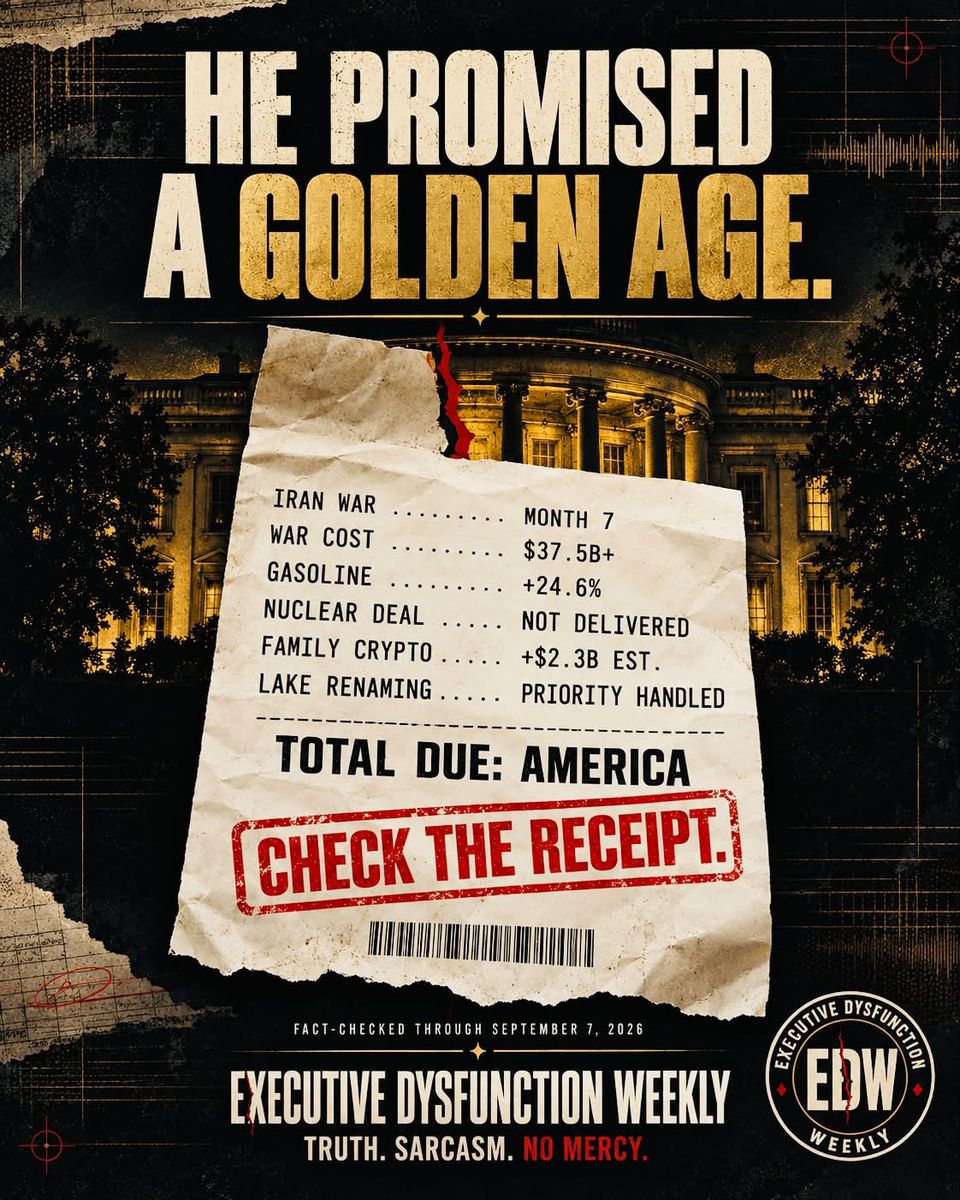
The economy is growing. The squeeze is real. The war is still going. The family fortune is booming. And while the country counts grocery dollars and dwindling missiles, Trump is renaming lakes and polishing marble.
Donald Trump wrote the test himself.
He promised to end inflation, make America affordable again, restore peace in Europe and the Middle East, prevent World War III and rebuild the military. In his second inaugural address, he said his legacy would be measured not only by the battles America won, but by the wars it ended - and the wars it never entered.
Fine.
No curve. No participation trophy. No extra credit for renaming the lake.
As of September 7, the war with Iran has entered its seventh month. Eighteen American service members have been killed. The estimated cost has passed $37.5 billion. The temporary nuclear arrangement collapsed, the deadline for a permanent agreement expired, and the administration’s own energy secretary now says there may not be a nuclear agreement.
At home, gasoline was 24.6 percent more expensive in July than it had been one year earlier. Food was up 3 percent. The Agriculture Department expects beef and veal prices to rise 9.8 percent this year. Seventy-one percent of adults disapprove of Trump’s handling of the cost of living.
The federal workforce has been cut by roughly 12 percent. Important missile inventories are under documented strain. Confidence in American leadership has fallen among allies. Trump’s family, meanwhile, has added an estimated $2.3 billion to its fortune through its principal cryptocurrency ventures.
And the president has found time to direct the federal government to call Lake Ontario Lake America, promote New America as a replacement for New Mexico, fight over his name on the Kennedy Center and oversee a White House construction project whose internal cost estimate reportedly reached $600 million.
Let us begin with the facts Trump deserves to have included.
Real gross domestic product grew at a 1.5 percent annualized rate in the second quarter. Unemployment was 4.1 percent in August. The United States is not in an economic depression. Trump did, in fact, deliver the smaller federal workforce he promised. His pressure also helped produce higher defense-spending commitments from NATO members.
Those are accomplishments or favorable indicators, depending on the claim being measured.
They are not a permission slip to ignore the rest of the exam.
GDP does not end a war. A low unemployment rate does not make groceries affordable. A smaller government is not automatically a more capable one. Higher NATO spending does not erase collapsing confidence in American leadership. And a country can produce more total wealth while ordinary people find that their own money buys less life.
That is the pattern running through this presidency: announce the largest number, claim the grandest victory, attack anyone who reads the footnotes and generate a new spectacle before the public can compare the promise with the result.
The trick only works if we agree to grade the slogan instead of the outcome.
Peace, Now in Its Seventh Month
Trump did not merely say he wanted peace. He made peace a standard by which the public should judge him.
So judge him.
The Russia-Ukraine war is still grinding through its fifth year. American envoys have continued trying to revive stalled talks, but as of this fact check there was no breakthrough, and heavy fighting continued.
The administration says Iran’s nuclear program has been weakened and that Iran has not obtained a nuclear weapon. It argues that the United States is not engaged in the kind of ground war Americans associate with Iraq or Afghanistan. Vice President JD Vance has resisted calling the operation a war at all.
Those are relevant qualifications. They do not transform seven months of combat, 18 dead Americans and more than $37.5 billion in spending into a war America never entered.
Nor has the central diplomatic objective been secured. A temporary arrangement announced in June collapsed. A 60-day deadline for a permanent nuclear deal passed without one. On September 6, Energy Secretary Chris Wright said there “may not” be a nuclear agreement.
Could Iran’s nuclear capacity still be permanently constrained? Yes. Could a later settlement improve the outcome? Yes. No responsible person can write the final history of an active conflict.
But “the final outcome remains uncertain” is not the same sentence as “mission accomplished.”
The price is not limited to dollars and lives already lost. Reuters reported that the United States had used virtually all available Army long-range precision missiles in key categories during the conflict. The Associated Press later reported that American Patriot missile stocks in Europe were considered “beyond critical.”
The president promised to rebuild military strength and keep America out of new wars. He is now asking the country to treat an extended conflict, an unfinished nuclear objective and depleted categories of precision weapons as evidence that both promises are going beautifully.
Apparently the war is not a war, the cost is “small potatoes,” and the missing agreement is a detail.
The Dashboard Says Growth. The Receipt Says Something Else.
The economy is not fake. The squeeze is not imaginary.
Both statements can be true because the headline statistics and a household budget are answering different questions.
GDP tells us how much the country produced. It does not tell us who received the gains, whether rent consumed them or whether a family can still buy the house its income once bought. The unemployment rate measures unemployed people as a share of the civilian labor force. It generally requires active job search and availability, but also includes qualifying workers on temporary layoff awaiting recall. It does not tell us whether an applicant sent 40 résumés into a machine and heard nothing.
Inflation measures how quickly prices are rising. It does not mean prices returned to where they were.
That distance has a name: the Dashboard Gap.
In July, the Consumer Price Index was 3.4 percent higher than one year earlier. But the overall price level was about 27.7 percent higher than it had been in January 2021 and 5.1 percent higher than when Trump returned to office. Slower inflation means the hill is getting steeper more slowly. It does not move the shopper back down the hill.
The mix matters too. Food was up 3 percent over the year. Energy was up 14.7 percent. Gasoline was up 24.6 percent. Real average hourly earnings were slightly lower than a year earlier. Beef prices are being driven partly by a multiyear cattle cycle that predates this administration, which means blaming every dollar on Trump would be false.
It also means Trump cannot honestly take a victory lap past the meat counter.
The job market has its own optical illusion. Employers reported 7.3 million openings in July, but only 5.1 million hires. Quits were subdued. In August, nearly 1.9 million people had been unemployed for at least 27 weeks, and 4.4 million were working part time for economic reasons. In July, 5.9 million people outside the labor force said they wanted a job.
This is a low-hire, low-fire economy. It can feel stable to someone holding a good job and frozen to someone trying to find one, change careers or move up.
That helps explain why the public mood looks nothing like the ribbon-cutting speech.
In a late-August Reuters/Ipsos poll, 71 percent disapproved of Trump’s handling of the cost of living and only 22 percent approved. Nearly half of registered voters called the cost of living the single most important factor in their midterm vote. A Washington Post/Ipsos survey found that 65 percent considered groceries unaffordable and 59 percent did not believe people like them had a good chance to improve their standard of living. Gallup found 67 percent saying the economy was getting worse. University of Michigan consumer sentiment fell across political groups in August and was 11.2 percent lower than one year earlier, with an especially pronounced decline among Republicans.
There is counterevidence here too. In the Federal Reserve’s household survey, 73 percent of adults still said they were doing okay or living comfortably. But 58 percent said price changes had worsened their finances, 16 percent had not paid all their bills in the prior month, and 37 percent said they would not cover a $400 emergency entirely with cash or its equivalent. “Everybody is broke” is false. “The squeeze is broad and reaches well beyond the poor” is not.
Personal stories do not establish a national rate. Polls are affected by wording, timing and partisanship. But when different surveys using different questions repeatedly find the same anxiety across income and political groups, “people feel squeezed” is no longer merely anecdotal.
Can an administration massage economic numbers?
It can massage the story far more easily than the underlying tables.
The research does not establish that the current CPI, GDP or employment series have been secretly fabricated. Their methods, revisions and limitations are public. Payroll estimates are eventually benchmarked against unemployment-insurance tax records covering nearly all employers. There are legitimate risks from falling response rates, reduced data collection, staffing losses and political pressure on statistical agencies. Those risks deserve scrutiny.
But a politician does not need to forge a number to mislead people with it.
He only needs to stand in front of the friendliest number and block the view of the next table.
Inflation rate, not price level. Openings, not hires. U-3 unemployment, not underemployment or job-finding. Annualized GDP, not the actual 0.4 percent quarterly increase. Average wages, not the household bill stack.
Every number can be true.
The story can still be bullshit.
Smaller Government, Larger Blind Spots
Trump promised to cut the federal government, and he did.
The Government Accountability Office counted nearly 378,000 departures and about 127,000 hires across the federal government in 2025. Every major agency it reviewed shrank, and most fell by more than 10 percent. Reuters calculated that the civilian federal workforce was about 12 percent smaller in January 2026 than it had been in September 2024.
The administration says the reduction made government more accountable and efficient. The Office of Personnel Management says more than 90 percent of expected departures were voluntary or the result of natural attrition. Those facts belong in any honest account.
So does the obvious question: smaller enough to do what?
A vacant chair saves a salary. It can also mean a delayed inspection, an unanswered benefit call, a grant that arrives after hiring season, a research program without the person who understands it or a statistical sample that quietly gets thinner.
At the Education Department, the inspector general documented at least 1,579 workforce reductions from a staff of 3,902 during the period reviewed - roughly 40 percent. It also documented 90 terminated grants worth about $504 million and 223 additional grants identified for termination worth roughly $252 million. The inspector general said access to some requested information was limited.
The public deserves a ledger showing not only how many positions vanished, but what stopped, slowed, degraded or improved after they did.
Otherwise DOGE is just another dashboard: enormous savings announced at the top, consequences distributed where nobody is filming.
A School Cut With No Name on It
Education is where all these layers become visible.
The actual squeeze is complicated. The Big Beautiful Bill makes enormous changes to Medicaid and SNAP, reduces projected federal spending, shifts costs and administrative burdens to states and changes eligibility. The Congressional Budget Office estimates its Medicaid provisions will reduce federal deficits by $886.8 billion over ten years and leave 7.5 million more people uninsured in 2034. CBO projects roughly 2.4 million fewer SNAP participants in an average month over 2025 through 2034 and about $35 billion in food-benefit costs shifted to states from 2028 through 2034.
Those are not direct teacher layoffs. They are pressure moving into state budgets that also pay for schools.
Schools themselves bill Medicaid for nursing, therapy, behavioral health and special-education services. The Urban Institute counted at least $8.1 billion in school-based Medicaid spending in fiscal year 2024, including $4.4 billion in federal money. If reimbursement becomes harder to obtain, a district cannot simply ignore a child’s legally required service. The mandate survives. Something else absorbs the cost.
The same pattern appears in food assistance. SNAP participation helps schools directly certify children for free meals. CBO projects that state responses to the law could reduce child-nutrition subsidies for about 96,000 children in an average month. That does not mean 2.4 million children lose lunch, and it does not happen everywhere at once. It means more applications, more administrative friction and potentially less reimbursement in schools already running out of room.
They were running out of room before this law. Pandemic relief expired. Enrollment has fallen in many districts. Health insurance, transportation, food, utilities and special education cost more. RAND found that 54 percent of district leaders ranked budget shortages among their three most pressing problems in spring 2026, up from 33 percent one year earlier.
In Washington state, the Legislature and governor - cut Transition to Kindergarten funding by 25 percent for 2026-27. Statewide funded capacity fell by the equivalent of nearly 2,000 slots. In Walla Walla, the allocation fell 17.7 percent, costing the district an estimated $213,400.
At the former Blue Ridge Elementary campus, now the Walla Walla Center for Children & Families, that state cut sits beside a separate federal story. The district received an interim Head Start award protecting 116 planned slots only through December 31. Northwest Public Broadcasting reported that grant uncertainty had already cost the program four of its 12 teaching assistants.
This is how a modern public-service cut works. Congress points to a maintained appropriation. The administration points to a grant still being processed. The state points to federal uncertainty. The district points to enrollment and labor costs. Everybody has a spreadsheet proving it was somebody else’s fault.
The spreadsheet is where ideology goes to acquire plausible deniability.
The student experiences every level of government as Tuesday.
The Family Business Found Its Golden Age
There is one part of the economy for which the phrase golden age appears painfully accurate.
Trump’s latest financial disclosure reported more than $1.4 billion in income connected to his family’s cryptocurrency projects, including World Liberty Financial and the Trump meme coin. A Reuters investigation estimated that Trump and his sons had added at least $2.3 billion to the family fortune through their main crypto ventures since he returned to office.
That establishes something that should be disturbing without embellishment.
The president retains a financial interest in businesses operating in an industry his administration regulates and promotes. While households are told to be patient about affordability, the first family’s private digital-asset empire has produced extraordinary gains.
The conflict is not hidden. It is branded.
The old theory of presidential ethics assumed that the appearance of self-dealing was itself dangerous because public power must not look available for private enrichment. The current theory appears to be that if the transaction is large enough, public enough and wrapped in enough patriotic merchandise, concern about it becomes a partisan personality defect.
No criminal conclusion is required to ask the democratic question:
Whose golden age arrived on time?
Our Allies Can Read a Poll Too
International confidence is measurable.
Pew found that across 36 countries, a median of 39 percent believed the United States respected the personal freedoms of its own people, while 56 percent said it did not. Assessments of the United States as a reliable partner fell sharply in several allied countries. Gallup measured median worldwide approval of U.S. leadership at 31 percent, below China’s 36 percent, and only 21 percent among NATO countries in 2025.
Trump’s NATO pressure did help drive higher defense commitments. Allies can spend more on their own security and trust American leadership less at the same time. In fact, they may spend more partly because they trust it less.
The administration’s relationship with the press shows the same preference for loyalty tests over neutral institutions. The White House restricted Associated Press access after the AP continued to use “Gulf of Mexico.” The Pentagon imposed access rules challenged by news organizations in court. The outcomes of that litigation have been mixed, but the underlying conduct is not imaginary: access to government was used as leverage in a dispute over language preferred by the president.
When the government punishes a wire service for refusing presidential vocabulary, the fight is not really about a gulf.
It is about whether the state gets to edit the dictionary and the witness list.
Meanwhile, Rename the Lake
Yes, the Lake America story is real.
Trump issued an executive order directing the federal government to use Lake America for Lake Ontario. That changes federal usage. It does not bind Canada, which shares the lake and is under no obligation to participate in the bit.
Yes, he really promoted New America as a replacement for New Mexico.
No, he cannot simply rename a state. A president controls neither New Mexico’s constitution nor its sovereign identity by social-media decree. As of this fact check, Trump had posted the idea and altered maps, but had issued no valid order accomplishing it because no such unilateral presidential power exists.
The governor of New Mexico had the proportionate response: the name predates the United States, and it is not negotiable.
Elsewhere, Trump’s appointees put his name on the Kennedy Center, triggering litigation and court orders. The White House initially presented its ballroom as a $200 million privately financed project. Internal contractor records later obtained by The Washington Post reportedly contained a $600 million estimate, with more than half potentially borne by taxpayers. The administration disputes parts of the reporting, and the final bill is not yet a settled number.
The number is unsettled.
The marble is not.
Add the Rose Garden, the Reflecting Pool, a proposed monumental arch and the rest of the capital makeover, and a theme becomes difficult to miss. This is a presidency unusually interested in the government’s surfaces: the names, the stone, the gold, the facade and the placement of the president inside the picture.
The Trolling Is the Product
Trump understands the attention economy better than most of the people paid to cover him.
He introduces an absurdity with just enough official power behind it to make ignoring it irresponsible. Reporters have to explain whether he can rename the state. Governors have to respond. Canadians have to clarify the name of their own lake. Comedians repeat the phrase. Opponents rage. Supporters enjoy the rage. For 24 hours, everyone is living inside the president’s chosen noun.
That is not merely distraction. It is agenda control through provocation.
The bait does not need to conceal a single secret. It only needs to consume the limited space in which the public might otherwise compare outcomes with promises.
While everyone argues about New America, fewer people are discussing the missing Iran agreement. While television debates whether a lake can be renamed, the details about missile inventories live below the fold. While critics recoil at the gold and marble, another federal grant arrives late enough to hollow out a program that was never technically cut.
The mistake is not covering the spectacle. A president asserting power over public names and public buildings is news.
The mistake is allowing the spectacle to become the whole story.
Every time Trump throws a flaming noun into the room, the answer should be the same:
Fine. We saw it. Now show us the receipt.
Check the Receipt
Trump voters do not need to be insulted. They need the same thing every voter deserves: an accounting.
The man promised peace. The country is in month seven of a war.
He promised affordability. Food and fuel costs are rising, real hourly pay has recently slipped, and large majorities say the squeeze is real.
He promised military strength. Specific precision-missile inventories are under serious strain.
He promised efficiency. Government is smaller; whether it works better remains conspicuously unproved, while grants, expertise and services show visible disruption.
He promised America first. His family’s crypto fortune appears to have arrived first.
An ongoing war. No permanent nuclear deal. Higher grocery and gasoline prices. Strained missile stocks. A hollowed federal workforce. Schools absorbing costs through a maze of indirect pressure. Falling confidence among allies. A first family collecting billions from crypto ventures. A lake with a new federal name and a state the president would like to turn into a punchline.
Trump wrote the test. He chose the promises. He told us how to grade him.
Put the receipt on the table.
Executive Dysfunction Weekly
Truth. Sarcasm. No Mercy.