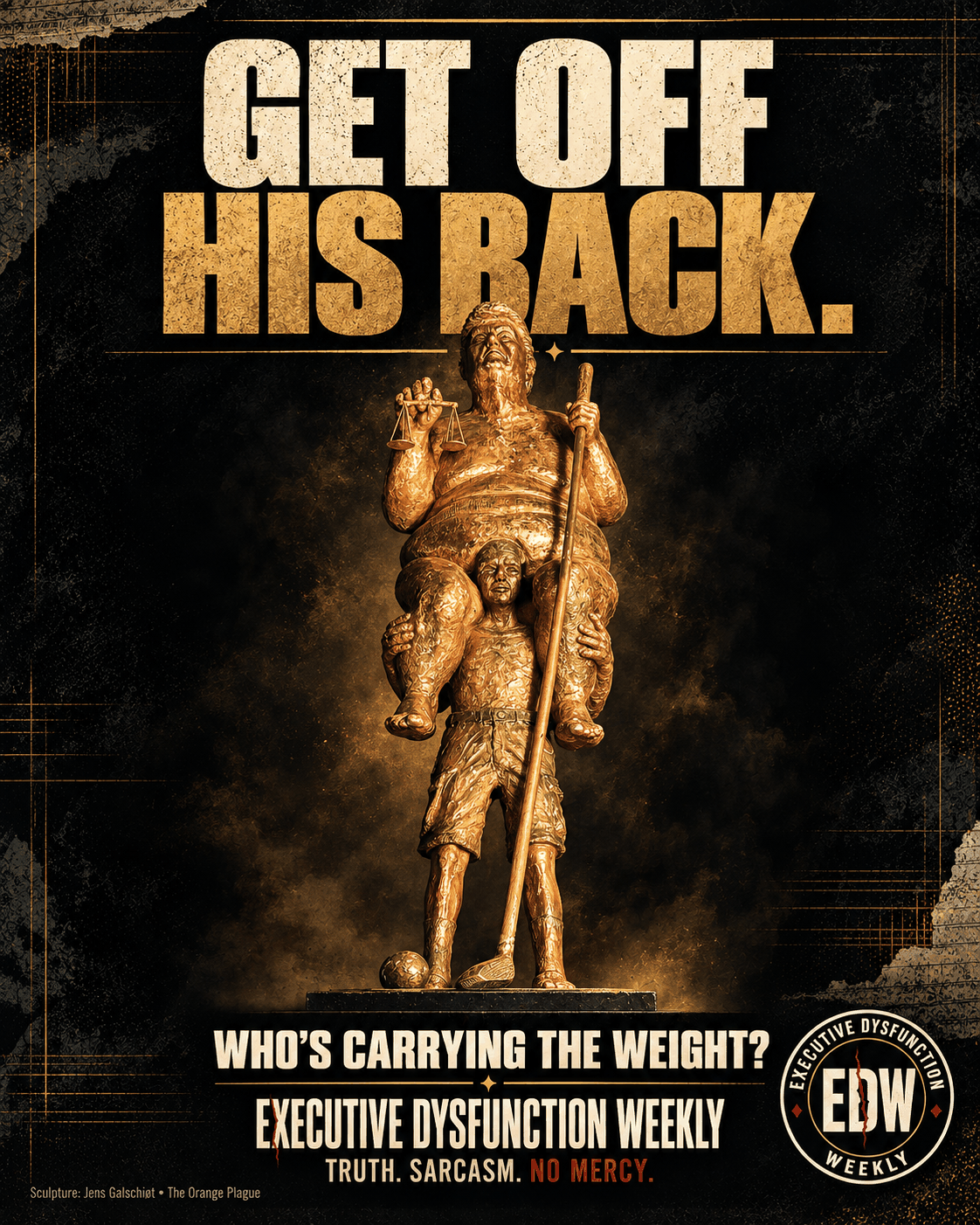
The gold gets your attention.
A naked Donald Trump, holding a golf club and a little set of scales, sits on the shoulders of a frail man.
Then you read the inscription:
“I will do anything to help him. Except stepping down from his back.”
And suddenly the naked-Trump joke has somewhere much more uncomfortable to go.
Look at the man underneath.
I keep coming back to him.
The sculpture is called The Orange Plague, by Danish artist Jens Galschiøt. This week, it appeared inside the European Parliament building in Strasbourg as part of a three-day exhibition hosted by Danish MEP Per Clausen. That matters: an invited exhibition is different from the European Parliament collectively commissioning a monument to tell Trump to fuck off.
The actual story is interesting enough.
An artist has put a relationship in front of us. One man carries the weight. The other has the position, the gold, and a declaration of concern.
The help is apparently going to arrive without disturbing the arrangement.
There is quite a collection of Trump protest art by now. INDECLINE put naked Trump statues in five American cities in 2016. London got the Trump Baby blimp in 2018. Viareggio, Italy, got a towering armored Trump carnival float in 2019.
I can laugh at that stuff.
But laughter can be a very quick transaction. You recognize somebody you dislike, enjoy seeing him made ridiculous, and move on.
This sculpture gives me something I have a harder time moving past.
Who is doing the carrying?
And why are we spending so much time looking at the guy on top?
Galschiøt describes his work as a protest against Trump’s threat to climate cooperation and the international order. That’s the artist’s stated argument. He is looking at consequences that extend beyond the country that elected Trump.
That seems worth remembering when we ask why somebody in Denmark cares so much about an American president.
We get a vote in our presidential elections. People elsewhere get consequences.
You don’t have to agree with every conclusion a foreign artist reaches to be curious about what he sees. What is he worried about? What experience is he bringing? What might we have become accustomed to that still looks extraordinary from outside?
“Why do you care?” can be an honest question.
It can also be a way to avoid hearing the answer.
Trump made his own promises.
In his November 2024 victory speech, he said: “I’m not going to start a war. I’m going to stop wars.” He also campaigned on cutting energy costs in half.
By October 8, 2026, AAA put the national average for regular gasoline at about $4.36 a gallon, compared with about $3.12 a year earlier. Diesel was about $6.28.
The war with Iran has disrupted the flow of oil through the Strait of Hormuz and helped push fuel prices higher. Other pressures matter, too; Reuters has also reported the effect of Ukrainian attacks on Russian refineries. A president doesn’t control every part of the price at the pump.
He does make decisions about going to war.
And when the consequences arrive, the people who believed the promises still have to get to work.
They don’t get to pay for gas with an explanation of why the promise was more complicated than it sounded.
Of course, a higher fuel bill is only one part of the burden. People living through the fighting, service members sent into danger, and families waiting for news carry costs that cannot be reduced to a price per gallon.
That is why the question has to be bigger than whether a president looks strong.
What has he made safer? Whose life has become harder? What would have to change before he admitted the policy needed to change?
Meanwhile, there is the money.
A Reuters investigation published in June found that Trump’s family had made at least $2.3 billion in profits from its main crypto ventures since his return to office. Its analysis estimated investors’ net losses at $2.3 billion through April, including losses on investments they still held. The White House denied conflicts of interest.
A sitting president’s family is profiting from an industry his administration regulates.
That deserves scrutiny regardless of whether somebody has proved a criminal exchange of favors.
And I can already hear the answer.
What about the Obamas? The Clintons? The Bidens?
All right. Let’s talk about them.
I love the Obamas. I think they have done a great deal of good. I don’t have to pretend otherwise to examine how they made their money.
Their 2017 book agreement was reportedly worth more than $65 million. Joe and Jill Biden reported more than $15 million in income for 2017 and 2018, largely from books and speaking. CNN documented more than $153 million in paid speeches for Bill and Hillary Clinton between 2001 and the spring of 2015.
Those are enormous sums.
Obama also agreed to a reported $400,000 speaking fee for a Wall Street firm’s conference after leaving office.
I understand why that bothers people. I understand why a conservative hearing Democrats talk about concentrated wealth might look at those checks and ask how seriously we mean it.
If my response is to dismiss the question because I like Obama, I am doing the tribal shit I keep complaining about.
But the answer still requires distinctions.
A book that people want to read, a corporate speaking fee, and a business that can benefit from decisions made by its owner in public office raise different questions. Timing matters. Who pays matters. What they receive matters.
Nor can I add donations to a charitable foundation to a family’s personal fortune as though those were the same money. I can value the work of the Clinton Foundation and still want hard questions asked about donors and access.
Becoming wealthy does not, by itself, establish corruption.
I need evidence of what somebody did. Who benefited? Was access being sold? Was public authority used for private advantage?
There is also a question that remains even when nobody has broken the law: are we comfortable with the relationship between political power and private reward?
I don’t want admiration to make me stop asking.
I also don’t want “they all do it” to become permission for the next person to do whatever the fuck he wants.
If money buying influence bothers us, each example gives us another reason to demand better rules. It doesn’t cancel out the example before it.
That brings me back to the sculpture.
The person underneath deserves our attention even when we admire the person on top.
And even when the person underneath voted differently from us.
I’ve heard Democrats talk about the party they want to have when Trump dies. I’ve heard it said with an eagerness that makes me uncomfortable, sometimes in ways that seem intended to make Republicans hear it and hurt.
I think that’s fucking sick.
I want Trump held accountable for what he does. I want harmful policies stopped. I want people protected. There is plenty to fight for while a man is alive.
Planning a celebration of his death asks something different of us. What are we hoping to enjoy? The end of the harm? The pain of people who cared about him? Have we bothered to separate those things?
And I remember the cruelty directed at Biden, too. Republicans who recognize something ugly in these conversations ought to recognize it when the target changes.
Someone else’s cruelty does not settle what I should do with mine.
We keep finding permission in what was done to us.
They humiliated us. They laughed at our fears. They said things about people we loved. Now we want them to feel it.
“Do unto others as you would have them do unto you” becomes “Do unto others what was done to me.”
Then we act surprised when the next person wants revenge.
I hear a version of this among Democrats that we need to confront: the satisfaction in telling people they deserve whatever happens to them because of how they voted.
“You voted for this.”
Sometimes that is a necessary conversation about consequences. People should have to examine what they supported.
But “you deserve to suffer” takes that conversation somewhere else.
If somebody cannot afford groceries, loses access to healthcare, or fears for a child sent to war, I don’t want their pain to become a little victory for me.
What, exactly, have I won?
The bill is still unpaid. The care is still missing. The family is still frightened. I’ve added my satisfaction to their burden.
And if somebody begins questioning a vote, what do I want to happen next? Do I want to hear them out, or make them regret admitting it?
We cannot keep demanding that people reconsider their loyalties while treating every admission of doubt as an opportunity to humiliate them.
I think this is one of the ugliest habits on my side of politics. We talk about compassion, then sometimes make people pass a political test before we offer any.
I can do better, too.
That has to mean something when I’m angry. When I think I was right. When somebody’s trouble seems to prove the thing I warned them about.
I still want the truth told. I still want responsibility taken. I want rules that protect people regardless of who they voted for, including people who would never return the favor.
Looking at that sculpture, I have to ask what I’m contributing.
Am I trying to make the man’s burden lighter?
Or am I standing beside him, explaining why he deserves the weight?
There is something lasting about this kind of art, too. The Trump Baby blimp entered London Museum’s collection in 2021. Conservators have worked on how to preserve it. An object made for a protest has become something people are trying to keep for the future.
That interests me.
A powerful person can commission an image of himself. Other people get to make images of what living with his power felt like.
Both can survive.
We cannot know which one will mean more to somebody looking back.
I started looking at this sculpture because it was another outrageous image of Trump. Now I keep thinking about how easily the person underneath could disappear from the conversation.
We could argue about whether the statue is offensive. We could debate whether Europeans have any business criticizing us. We could trade insults about the artist, the audience, and each other’s intelligence.
The man would still be carrying him.
I want to know what would make his burden lighter.
If you say you will do anything to help him, start there.
Get off his fucking back.
EDW•