In 1950, Walla Walla called itself typically American because families brought their cultures and food with them. Seventy-six years later, the White House describes unauthorized migration as an invasion.
I spent a day reading the October 1, 1950, edition of the Walla Walla Union-Bulletin.
The front page was war, communism, taxes, public construction and political argument. The editorial page warned about Russia, government debt and “the road to socialism.” Advertisements promised hormone creams, miracle medicines and better husbands through tractor ownership.
Men needed jobs. Women needed complexions. America was busy being America.
Then page 17 kicked the entire modern immigration debate in the teeth.
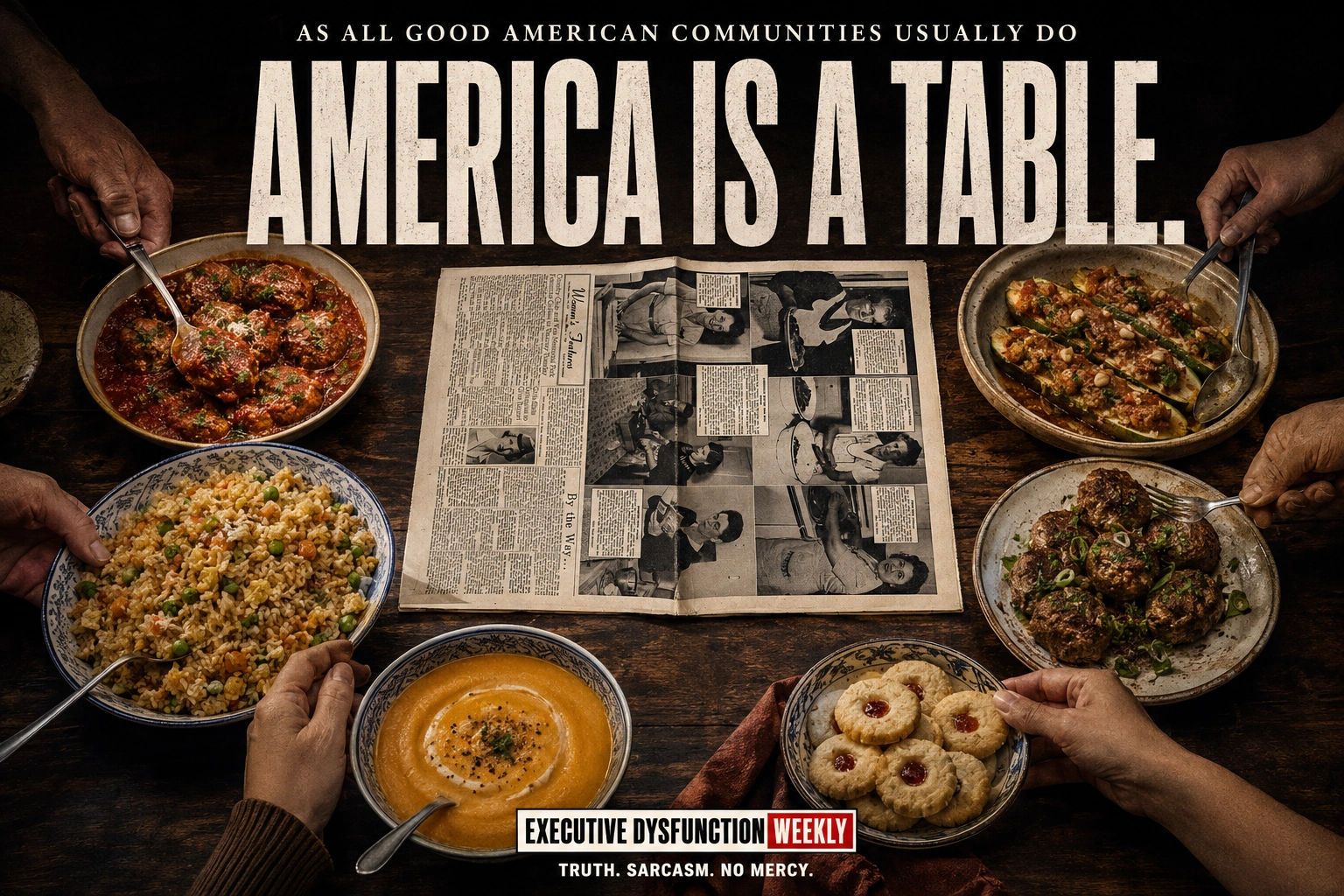
It was the women’s page. Buried between society announcements and a golf tournament was a feature called “International Potpourri.” It described quiet, inland Walla Walla as “typically America” because it reflected many national and racial backgrounds, “as all good American communities usually do.”
That was the phrase.
Not as dangerously changing communities do.
Not as invaded communities do.
As all good American communities do.
The evidence was dinner.
There were Italian meatballs from Mrs. Robert Lamperti. Chinese fried rice from Mrs. Yen Tom. Lebanese stuffed zucchini from Mrs. A.J. Nahmy. Iranian and Azerbaijani kufteh from Mrs. Tom Allen. French pumpkin soup from Mlle. Paule Ravassel. Norwegian King Haakon cookies.
Families had carried these recipes across oceans and generations until they reached Walla Walla kitchens.
The newspaper did not describe that as the destruction of American culture.
It described it as American culture.
Seventy-six years later, the White House has titled an immigration-enforcement order “Protecting the American People Against Invasion.” In February 2026, it publicly recommitted itself to “the largest mass-deportation effort in our Nation’s history.”
Apparently the melting pot has been reclassified as a crime scene.
Let’s be precise, because immigration arguments become useless when everybody starts lying about what the other side believes.
A country is allowed to have borders. Immigration laws must be enforced. The asylum system needs to function. Labor markets, housing, schools and hospitals have real limits that governments must plan for. People who commit serious crimes should face the law, regardless of where they were born.
None of that requires describing millions of human beings as an invading army.
Enforcement is a policy. Dehumanization is propaganda.
In 1950, 6.9 percent of the United States population was foreign-born. By 2024, the figure was an estimated 14.8 percent. That is a substantial change, and pretending otherwise insults people who are honestly concerned about whether the country can absorb growth successfully.
But population change is not proof of national collapse.
More than half of today’s foreign-born residents are naturalized citizens. In Walla Walla County, 9.5 percent of residents are foreign-born, one-quarter are Hispanic or Latino, and roughly one in five residents speaks a language other than English at home.
They are not standing outside Walla Walla waiting to replace it.
They are Walla Walla.
They work here. Own homes here. Raise children here. Start businesses here. Pay taxes here. Worship here. Coach teams here. Cook here. Bury parents here. Worry about grocery prices here. Complain about politicians here.
That last one is practically the citizenship test.
Now, let’s not turn 1950 into a Hallmark movie.
This newspaper was not some lost progressive paradise. It divided employment listings into jobs for men and jobs for women. Many married women were denied even their own first names and identified through their husbands. A headline about Native treaty rights used the word “Paleface.” Foreign cultures could be presented as charming curiosities instead of equal parts of the country.
The past was more openly prejudiced than the present in ways that should not be softened by sepia ink and nostalgia.
That is exactly what makes page 17 so powerful.
Even inside that deeply imperfect America, ordinary people understood that different backgrounds did not make a community less American. They were part of what made it typically American.
The recipe page understood the country better than the fear merchants do.
There has never been a finished version of America for newcomers to contaminate. America has always been under construction. Most non-Native American families trace their presence here to migration (voluntary or forced, recent or distant), and every generation argued about whether the next people through the door belonged.
Then the newcomers worked. Their children grew up. What had been called foreign became familiar. Their food stayed. People who once inspired suspicion became somebody’s grandmother.
That is how Italian meatballs reached a Walla Walla newspaper.
That is how Chinese fried rice became an American weeknight dinner.
That is how a Lebanese family recipe stopped being something from somewhere else and became the dish the neighbors hoped would appear at the potluck.
This is not cultural erasure. It is cultural inheritance.
When politicians turn migrants into a faceless invading mass, they are not protecting American identity. They are stripping individual people of names, families, work and history so fear can be sold wholesale.
It is easier to hate an invasion than Mrs. Yen Tom.
It is easier to campaign against a horde than against the person who works beside you, whose child shares a classroom with yours, or whose grandmother’s recipe you have been eating for seventy-six years.
The oldest trick in politics is to take complicated human beings and replace them with a frightening noun.
Alien.
Invader.
Criminal.
Replacement.
Once the person disappears, cruelty can dress itself as patriotism.
But patriotism is not fear of everyone who arrived later than your family did.
Patriotism is confidence that the American idea is strong enough to be shared and disciplined enough to enforce laws without surrendering its humanity.
America is not a bloodline.
It is not a museum display sealed against fingerprints.
It is not a recipe protected from contamination.
America is a table.
People arrive carrying what they have. They add it to what was already here. Some of it clashes. Some of it changes. Some of it becomes so familiar that everyone forgets it was ever considered foreign.
In 1950, Walla Walla knew exactly what made a good American community.
Everybody brought something.
Everybody ate.
Executive Dysfunction Weekly
Truth. Sarcasm. No Mercy.