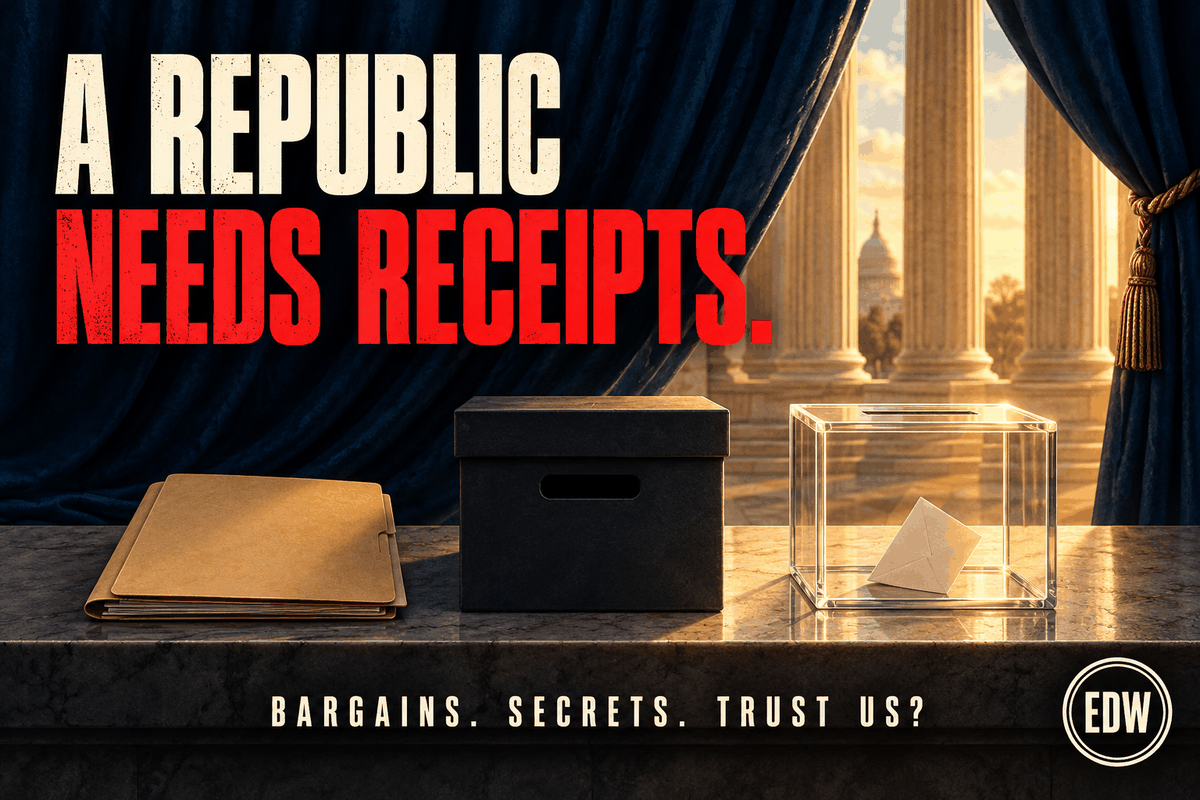
In the same week, Americans watched three different institutions behave as if the old guardrails don’t matter anymore.
A federal judge in Minnesota had to say out loud what should never need saying: a court order is not advisory. He warned that detention without lawful authority is a constitutional injury, and that “volume” is not a justification for cutting constitutional corners, if anything, it is a warning sign that the operation has outgrown lawful capacity. He described the government’s repeated failure to comply with release orders as an institutional breakdown, not a paperwork problem. When a court is “ferreting out” whether people were actually released, days after the order, the issue is not administrative friction, it’s whether the executive branch still treats judicial authority as binding.
At the same time, we’re seeing the normalization of something else: truth as a commodity. Ghislaine Maxwell, through counsel, reportedly refused to answer questions in a closed-door House Oversight deposition by invoking the Fifth Amendment, and her lawyer suggested she would be willing to “clear” President Trump and Bill Clinton of wrongdoing if she received clemency. That is not “closure.” That is a transactional offer: give me freedom, and I’ll give you a story. Whether you are left, right, or independent, that should make your stomach turn. Justice cannot function when testimony is treated like a bargaining chip for powerful outcomes rather than a duty compelled by law.
And then there is the most corrosive category of all: power grasping for control of the referee. According to an Associated Press report, after the FBI seized Georgia ballots and voting records as part of an election investigation, President Trump said the federal government should “take over” elections and move toward nationalizing them, framing it as a response to places he says he won. Regardless of anyone’s feelings about 2020, that kind of rhetoric goes to the heart of a constitutional republic: when the executive branch signals it wants more control over election administration, it is not merely “politics.” It is pressure on the system that decides who holds power next.
These are different headlines. They are the same disease.
The Founders built a system that assumes humans will abuse power. That is why the Constitution is full of friction, courts checking executives, legislatures checking presidents, states checking centralized authority. Madison warned that “the accumulation of all powers, legislative, executive, and judiciary, in the same hands … may justly be pronounced the very definition of tyranny.”
And in Federalist 51, the logic is as blunt as it is timeless: “If men were angels, no government would be necessary.” The whole design is to “oblige” government to control itself, and to create what Madison called a “double security” for rights through federalism and separated powers.
What we are watching now is not one party’s sin or one leader’s temperament. It is a pattern: institutions acting like constraints are optional, and citizens being trained to accept it as normal. That is how republics weaken, not always with tanks, but with habits. With exceptions. With “just this once.” With “trust us.” With the quiet redefinition of what counts as a warrant, what counts as oversight, what counts as accountability, what counts as a free press, what counts as an election system that belongs to the people rather than the party in power.
So what do we do, without pretending we can amend the Constitution in today’s political environment?
We stop hemorrhaging where we can. Congress can pass guardrails that force daylight into the system without amending the Constitution. Ordinary bills can pass by simple majorities, but Senate cloture generally requires 60 votes, and overriding a presidential veto requires two-thirds of each chamber.
Congress can codify strict, logged, auditable rules for communications between the White House and DOJ/FBI leadership, so “backchannel” influence becomes legally risky and institutionally visible. You cannot separate DOJ from the executive branch in a literal sense, but you can make political interference harder to hide.
Congress can give itself real subpoena teeth through fast-track judicial enforcement and meaningful penalties for noncompliance, because “oversight” that can be stalled into irrelevance is not oversight.
Congress can require clear identification standards and body-camera policies for federal agents engaged in domestic enforcement actions, with strong evidence-preservation rules and independent review triggers when civilians are harmed. If the government expects the public to believe its version of events, it must stop asking for faith and start providing verifiable record.
Congress can strengthen inspectors general and whistleblower protections so that internal “this is illegal” alarms don’t end careers while misconduct gets promoted.
None of this requires you to become a partisan. It requires you to become a citizen again.
The most dangerous lie in American politics is that we must choose between “my side wins” and “the country survives.” The country survives when we refuse to reward the destruction of neutral rules. When we demand transparency even when it inconveniences “our” team. When we insist that courts are obeyed, evidence is preserved, elections are not seized by would-be referees, and justice is not auctioned for clemency.
A republic is not a vibe. It is a discipline.
And discipline is what we are losing.
EDW•