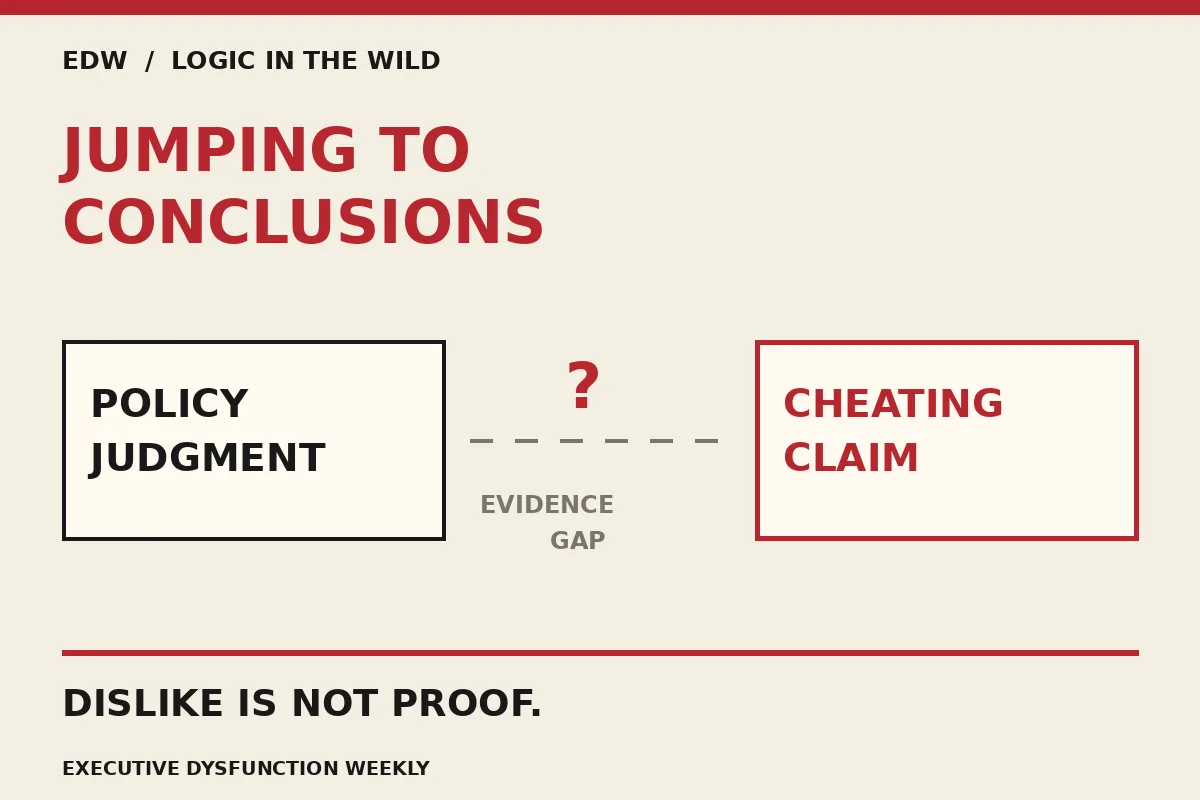
The claim
At his November 1 rally in Dubuque, Iowa, President Donald Trump argued for paper ballots and watermarks, then connected Democratic policies to a claim about election cheating. In the Roll Call/Factba.se transcript, he says “they have to cheat because without, look, their policies are so bad.”
The wording is disfluent, but the connection is clear in context: his negative judgment of the policies is offered as a reason Democrats need cheating to win. He follows it with a list of positions he attributes to them. ABC’s contemporaneous report independently records the passage and its paper-ballot context.
Where the reasoning breaks
Calling an opponent’s policies bad is a political judgment. It does not establish how voters evaluate those policies. Voters may disagree with the judgment, prioritize different issues, prefer a particular candidate, or dislike the alternative more. None of those possibilities requires a dishonest ballot.
There is another missing step even if we grant the stronger premise that a platform is genuinely unpopular. Electoral weakness does not establish electoral misconduct. A claim of cheating needs evidence about conduct, not merely an explanation of why the speaker thinks the other side deserves to lose.
This is jumping to conclusions: the conclusion outruns the support offered for it. More specifically, the inference does not follow from the stated premise. A policy review is not a fraud report, even if both arrive in a very serious folder.
The argument also excludes legitimate alternatives without demonstrating that they are unavailable. It moves from a judgment that Democrats should lose to a claim that they need cheating to win. Those are different propositions. Adding confidence does not build the missing bridge.
The strongest fair reading
The strongest fair interpretation is campaign hyperbole: Trump is expressing confidence that voters will reject the Democratic agenda while advocating election safeguards. A rally line is not a seminar paper, and calling for safeguards is not itself a reasoning error.
That reading softens how literally to take the prediction. It does not make policy disapproval evidence for a categorical cheating claim. If the intended argument is that particular misconduct occurred or is planned, the relevant next step is to identify the conduct and the supporting evidence.
The policy judgment is opinion. The policy descriptions that follow it may contain separately testable or disputed premises; this entry does not adjudicate that whole list. The necessity-of-cheating claim reaches beyond an opinion into an assertion about electoral legitimacy. The defect examined here is its unsupported inference, not a finding that every possible fraud allegation is false. Nor does this analysis establish anyone’s private intentions.
Why it matters
Before treating an unwelcome result as proof of wrongdoing, separate three questions: Do I dislike the platform? Did enough voters support the candidate? Is there evidence of misconduct? Answering the first does not complete the other two.
This edition evaluates a pre-election argument, not any November 3 result. Ballots do not become suspicious merely because they failed to consult your policy preferences.