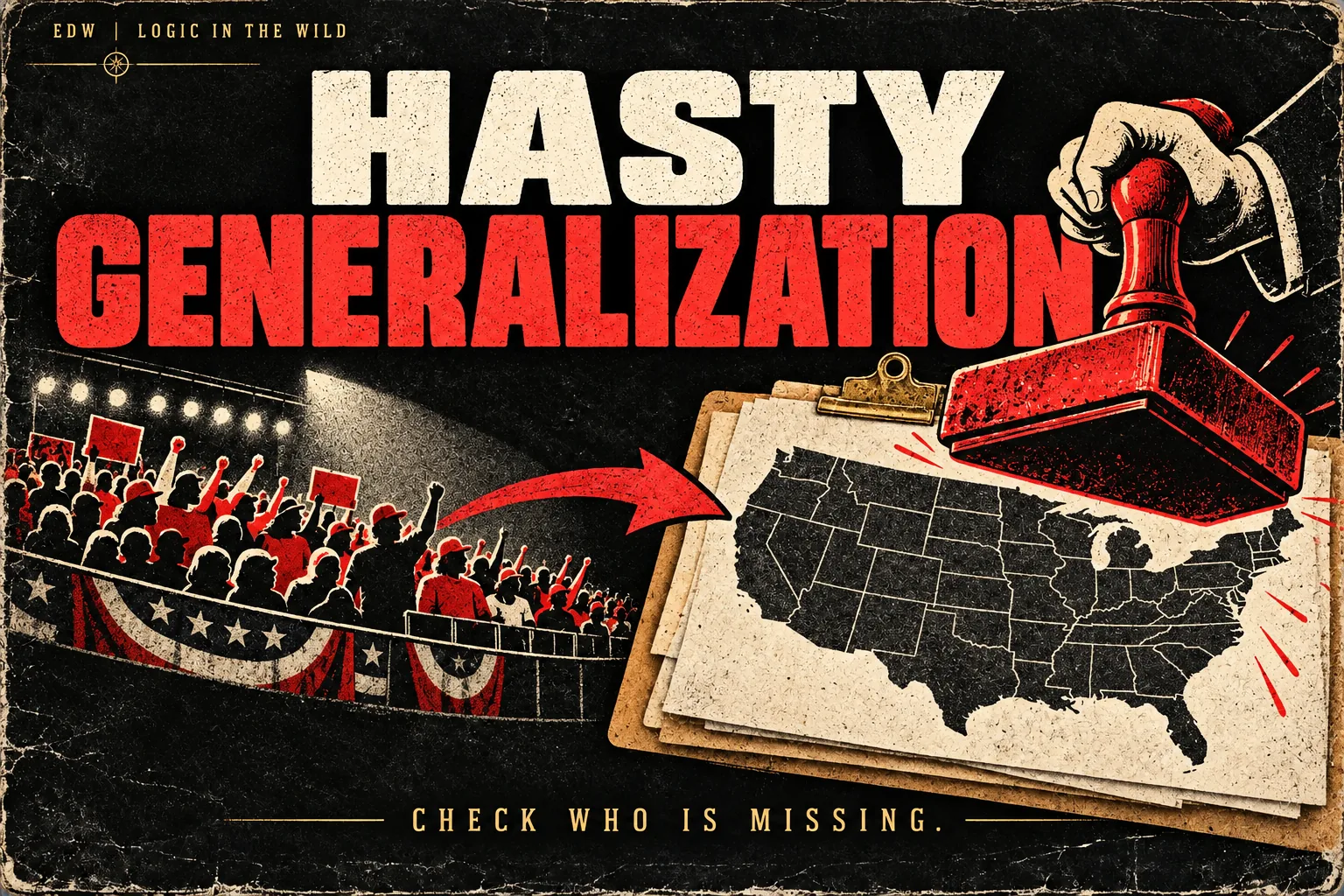
The claim
At his October 23 rally in Fort Myers, Florida, President Donald Trump said: “The Republicans have far more energy, I see their energy. We have fun; look at this place.” The passage appears at 12:14–12:36 in the Factba.se transcript.
He had just dismissed reports about Democratic enthusiasm. He followed with comparisons to Democratic rallies, including anecdotes about Bernie Sanders and Beto O’Rourke. The claim reaches beyond the people in front of him to a comparison between the parties.
Where the reasoning breaks
Start by giving the crowd its due. WGCU reported a packed Alico Arena and people turned away. There was real enthusiasm in that room. We do not need to pretend the seats were empty to examine the argument.
The missing step is representativeness. People who choose to attend a political rally have already passed an enthusiasm test that most voters never took. They made time, traveled and waited. Measuring political energy there selects for the thing being measured.
That makes the broader comparison a hasty generalization: extending evidence from selected audiences further than it can reliably carry us. A packed room tells us something about the people who filled it. Comparing the wider parties requires evidence about the people who stayed home, too.
Venue size, geography, timing, transportation and the attraction of a particular speaker all affect attendance. Even perfectly accurate crowd counts leave those differences unresolved. A bigger venue can contain more supporters and still represent a smaller share of the relevant electorate.
Imagine asking the front row at a concert whether the band has enthusiastic fans. Useful answer. Slight problem with using it to rank everyone else’s favorite band.
Reuters’ October 24 review described uneven attendance across Trump’s recent rallies. That context reinforces the need to examine how examples are selected. It does not establish an exact Fort Myers overflow count, and we are not supplying one.
The strongest fair reading
The strongest fair reading is a campaign pep talk: visible enthusiasm can help organizers, volunteers and supporters believe their work matters. Rallies can mobilize people as well as display support. A politician celebrating a lively crowd has not automatically committed a fallacy. The leap comes when that observation is offered to establish the wider comparison.
There is also relevant context later in the speech. Trump plays a CNN polling segment about strong MAGA Republican loyalty and intended support for Republican congressional candidates, beginning around 1:25:25 in the transcript. It would be misleading to say he offered no polling.
That segment concerns support within a subgroup. Even accepting those figures, it does not supply a comparable measure of enthusiasm across both parties’ electorates. Approval, candidate preference, rally attendance and likelihood of voting answer related but different questions.
Why it matters
With congressional elections approaching, claims about momentum can shape how people understand the race. Treat a rally as evidence of a rally, then ask what additional evidence supports the broader claim. Comparable surveys, clearly defined populations and transparent measures of intended participation would be more useful than competing camera angles. Those measures would still have uncertainty.
Keep the categories straight. Attendance is an empirical question. Describing an atmosphere as exciting is a judgment. Comparative electorate-wide enthusiasm is a claim requiring wider evidence. Inferring that comparison from selected crowds is the reasoning problem examined here.
This analysis neither establishes that Republicans are less enthusiastic nor predicts a Democratic victory. A poorly supported argument can reach a true conclusion. The support still needs work. We are evaluating the inference, not claiming access to the speaker’s private motives.
Use the same test for a packed Democratic rally, a viral post or your own cheering group chat. Check who is missing before declaring what everyone thinks.