The claim
On Sean Hannity’s October 16 podcast, Kansas Republican Sen. Roger Marshall said Democratic challenger Adam Hamilton “wants to shut down the beef industry.” His answer begins at 04:49 in the episode transcript, immediately after Hannity plays excerpts from Hamilton’s climate sermon.
The excerpt includes Hamilton suggesting dietary changes to reduce emissions. Marshall converts that advice into a claim about Hamilton’s intended treatment of an entire industry. That specific transition is our subject, not the other allegations in the interview.
Where the reasoning breaks
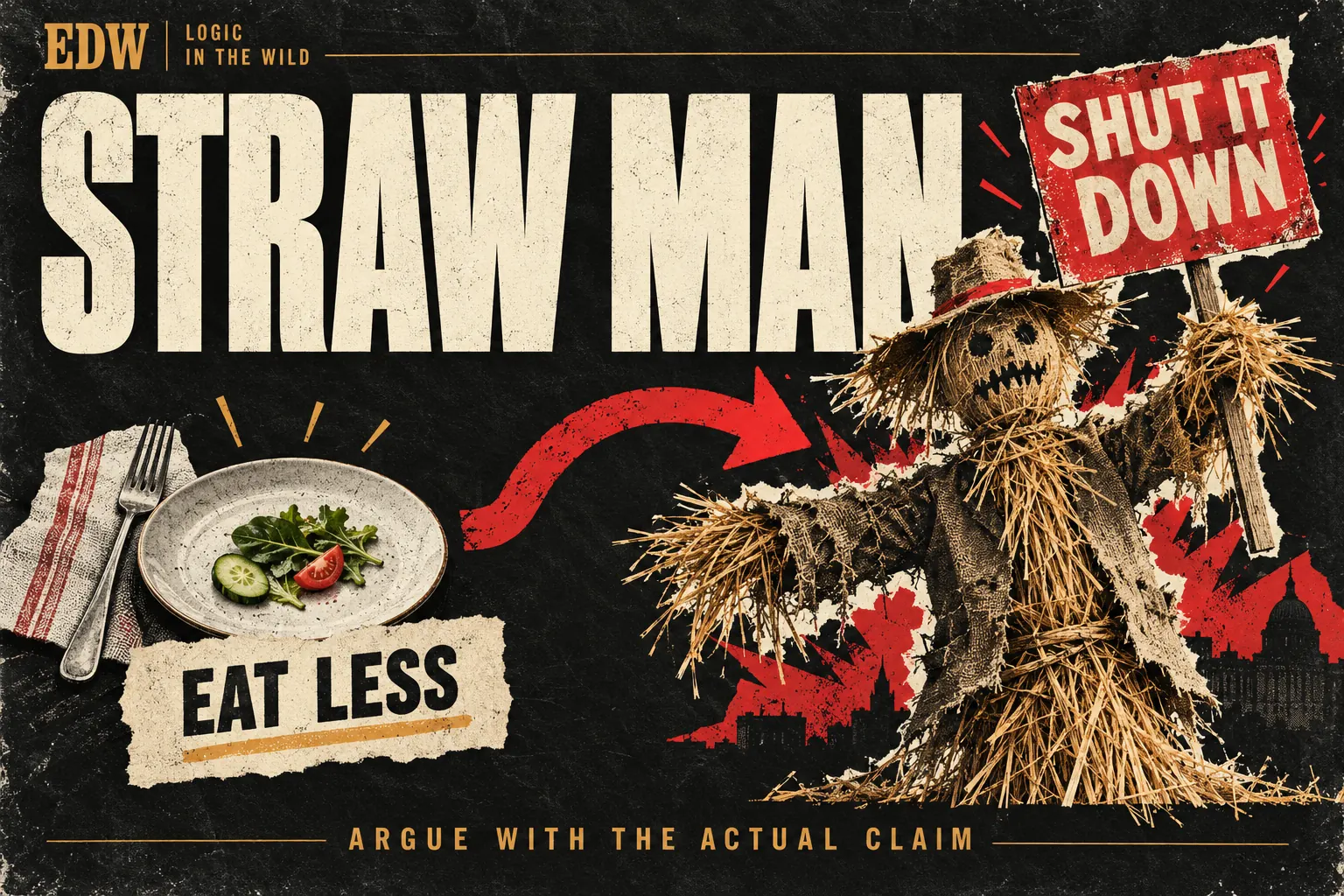
This is a straw man: replace someone’s actual position with a more extreme, easier-to-attack version, then argue against the replacement. Here, personal consumption advice becomes an industry shutdown. The scale changes, the means change, and the missing evidence apparently gets a ride in the cattle trailer.
At 04:16, the excerpt aired by Hannity has Hamilton discussing changes to what people eat as one way to reduce their environmental impact. Advice to consume less does not establish a desire to eliminate production. Nor does a sermon about individual behavior, by itself, establish a governmental ban.
PolitiFact’s October 20 review found no instance of Hamilton advocating a beef-industry shutdown. It also reported that Hamilton’s October 2 interview with Politico included support for Kansas cattle producers and discussion of reducing cattle methane through feed. Those statements are evidence of his expressed position, not a guarantee of what he would do in office.
The narrow defect is demonstrable without settling every climate-policy dispute: the position Marshall attacks is stronger than the position supported by the cited remarks. A scarecrow can be very easy to defeat. It rarely files a policy proposal.
The strongest fair reading
The strongest fair interpretation is concern for ranchers. Encouraging people to buy less beef could affect demand. A candidate’s climate priorities could also influence regulations, costs and investment. Voters are entitled to ask Hamilton how he would balance those concerns.
A serious criticism could identify a proposed restriction, estimate its effects and explain why his assurances are insufficient. It could challenge a tension between his earlier advice and his campaign’s emphasis. None of that requires pretending the tension has already become a shutdown plan.
If Marshall meant that Hamilton’s ideas could harm the industry, that is a prediction requiring its own evidence. It is not equivalent to the attributed intention that Hamilton wants the industry closed. We cannot quietly replace the claim with a more defensible one after the microphone is off.
Why it matters
Keep the categories separate. What Hamilton actually said is checkable. Whether consuming less beef is desirable is a policy or personal judgment. How a particular proposal would affect producers is an empirical question. Attributing an abolitionist position without establishing it is both an unsupported factual characterization and the premise that enables this straw-man argument.
Identifying that error does not prove Hamilton’s policies wise or economically harmless. It does not tell us Marshall’s private motives. It tells us which missing evidence the criticism needs.
Ask: What did the person actually propose? What changed in the retelling? Are we debating that proposal’s consequences, or attacking a substitute?
Before arguing with the scarecrow, check whether the person we disagree with ever ordered it.