The claim
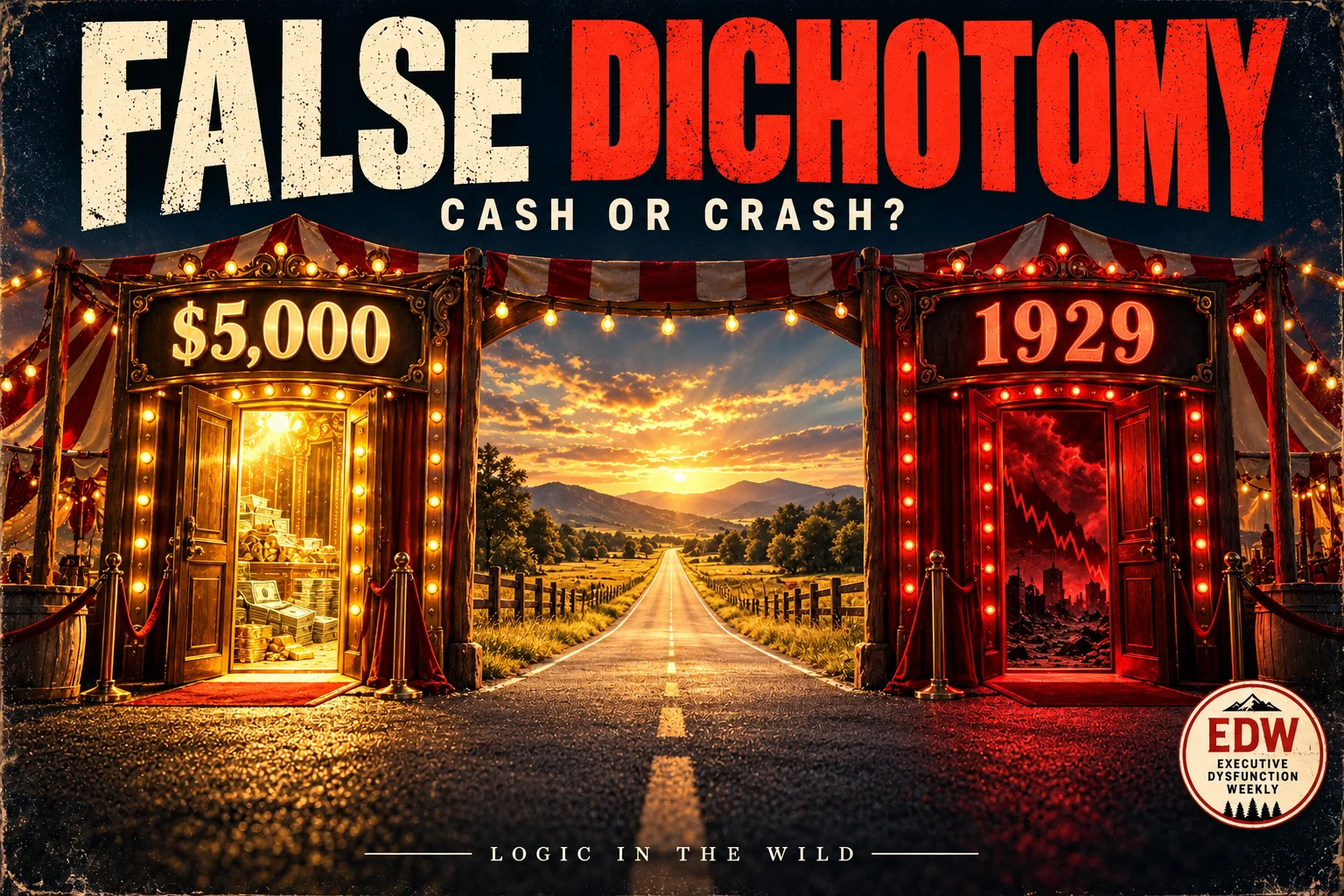
At his October 16 rally in Dalton, Georgia, President Trump presented a dramatic economic choice for the midterms. After criticizing Democratic tax policies, he said:
“But if the Democrats win, you will have a 1929 style economic depression.”
The warning appears at 50:50–51:10 in the Roll Call / Factba.se transcript. At 51:48–52:17, he contrasted it with a Republican victory, promising $5,000 and extraordinary economic success. Earlier, at 48:53–49:15, he specified adult U.S. citizens and a Republican win in both the House and Senate. He later described a roughly $1 trillion dividend, payable only if Republicans win, and said the money would have to be spent in the United States.
AP independently reported the repeated depression warning and conditional payment promise at his Kentucky rally the following day. Our quoted passage and timestamps are from Dalton.
Where the reasoning breaks
The problem is the certainty of the package: their victory delivers catastrophe; ours delivers cash and prosperity. That is a false dichotomy about economic outcomes. It is not a claim that the ballot lacks a real choice between competing candidates.
A congressional result does not, by itself, establish either forecast. To support the depression prediction, we would need a specific policy path, a credible explanation of its effects, evidence about scale and timing, and an account of why other outcomes are unlikely. Disliking a tax proposal does not fill in those steps.
The promised payment needs its own scrutiny. AP reports that the proposal would most likely require congressional approval. The House explains that legislation must pass both chambers in identical form before reaching the president. Winning seats is therefore not the same event as enacting and delivering a benefit.
The missing possibilities include a Democratic gain without a depression, or a Republican victory without the promised dividend or boom. These are logical alternatives, not our predictions. Showing that the speech has not ruled them out does not prove either will happen.
The economy is not a game show with two doors and a campaign volunteer hiding behind both. Ask what connects the election result to the outcome before accepting the prize package.
The strongest fair reading
The strongest fair reading is a forceful campaign warning: Trump believes Democratic policies would hurt growth, while a Republican Congress would help enact his economic agenda. Parties can have meaningfully different policies. Congressional control matters, and voters are entitled to weigh economic risks.
That argument could be defended with policy specifics and evidence. It does not justify treating a historic-scale collapse as the guaranteed consequence of the opposition winning. Nor does it establish a payment as a guaranteed consequence of his party winning.
The depression claim is a forecast, not an already-observed event we can simply mark false. His evaluation of the parties is political judgment; his assertion of inevitability outruns the support offered in this passage. Our interpretation is that the stark contrast encourages voters to associate one choice with reward and the other with fear. That describes the rhetoric, not private intent.
Why it matters
A frightening possibility deserves investigation. It does not become inevitable because someone says it loudly. And an attractive promise deserves a funding and implementation plan. It does not become money in your pocket because the crowd applauds.
Use three questions on either party: What exactly must happen between the vote and the promised result? What evidence supports each step? What other outcomes remain possible?
The next time a politician offers cash or catastrophe, ask to see the third door. Then ask for the paperwork.