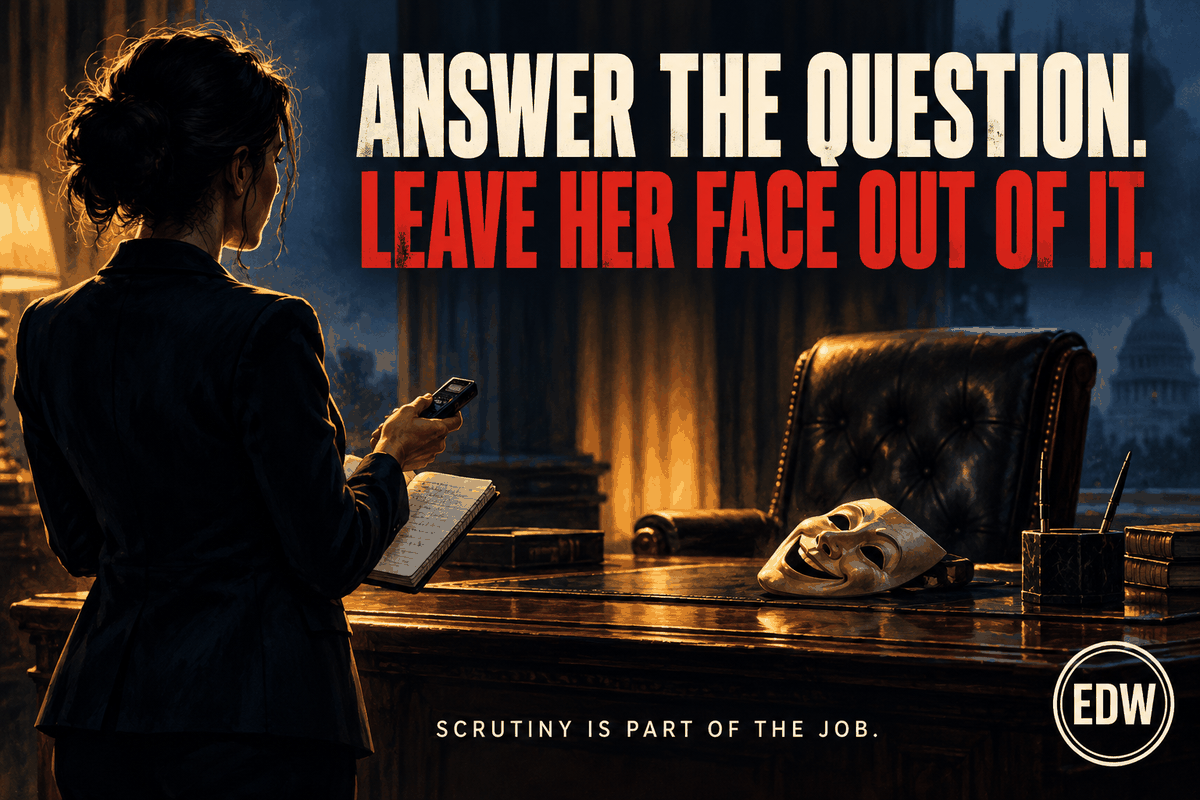
In the Oval Office on February 3, President Trump was asked a serious question by CNN’s Kaitlan Collins: what he would say to survivors of Jeffrey Epstein. It’s the kind of question a healthy country should be able to ask its leaders without the asker being humiliated for daring to ask it.
But instead of answering like a president, substance, facts, process, accountability, he did something else. He made it personal. He made it about her. He made it about her face.
“You are the worst reporter,” he said. He mocked her network’s ratings. Then he pivoted into a bizarre critique that had nothing to do with survivors, justice, or transparency: “I don’t think I’ve ever seen you smile… I’ve known you for 10 years, I don’t think I’ve ever seen a smile on your face.”
This isn’t just rude. It’s strategic.
When a powerful man responds to a question by judging a woman’s expression, her “smile,” her “attitude,” her “tone”, he is broadcasting a message to everyone watching: questions will be punished, and the punishment will be personal.
And that’s the whole point.
Because the “smile” line isn’t an argument. It’s not a rebuttal. It’s not evidence. It’s not even a coherent defense. It’s a dominance move, a way to change the subject from “What do you say to Epstein’s survivors?” to “Look at her. Look at how she looks. Look at how she talks.”
That’s an old playbook. Not presidential leadership, social intimidation.
What makes it worse is that this wasn’t a one-off. Trump has a documented pattern of publicly insulting women in the press corps, including calling Collins “stupid and nasty” in a prior post, and attacking other female reporters with appearance-based or degrading language.
So let’s name the logic problem plainly: this is ad hominem used as governance. When leaders can’t, or won’t, answer the question, they try to discredit the person asking it. And when it’s a woman, the attack often slides into the territory that has been used for generations to shut women up: “smile,” “quiet,” “ugly,” “nasty,” “piggy”, anything but the facts.
If you support Trump, pause for one second and flip the roles. If a Democratic president mocked a conservative female reporter’s face instead of answering a question about victims, would you call that strength? Or would you call it what it is: disrespect, deflection, and fear of scrutiny?
Because that’s what this is really about: scrutiny.
The Epstein question isn’t “gotcha.” Survivors exist. Their pain is real. The public’s demand for transparency is rational. A president who truly wants the country to trust institutions doesn’t sneer at accountability questions, he answers them, or he clearly explains what can and can’t be released and why.
In a constitutional republic, the press is not there to “be nice.” It’s there to ask what power doesn’t want asked. And when the president starts treating journalism like a personality contest, “smile more”, he’s training the country to stop expecting truth and start expecting performance.
That is how democracies rot: not all at once, but in little public humiliations that teach everyone else to stay quiet.
If you want more evidence-first, pro-democracy commentary that calls out bad faith without turning neighbors into enemies, please share this and follow Executive Dysfunction Weekly (EDW).
EDW•