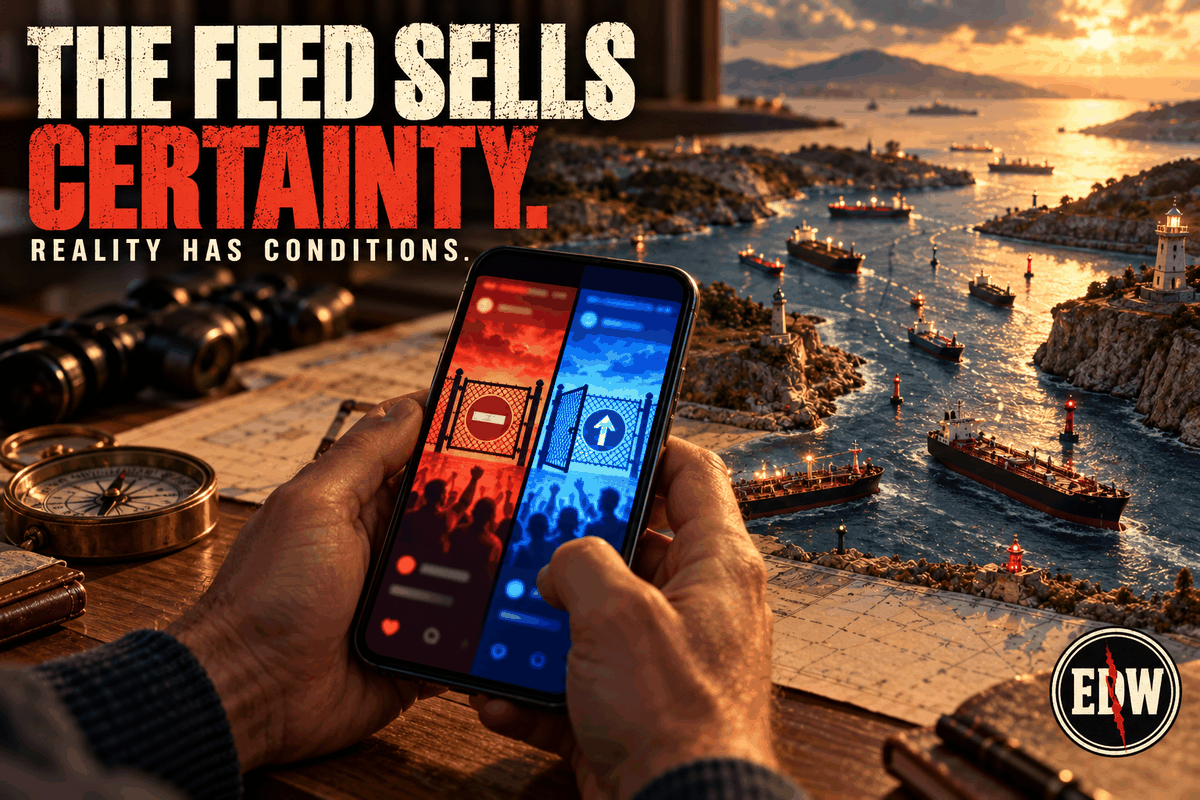
This Strait of Hormuz story is catnip for the algorithm because chaos sells better than clarity. One audience gets “Trump forced Iran to cave.” Another gets “the whole ceasefire collapsed.” Everybody gets a headline shaped like their team jersey, and the messier the truth gets, the easier it becomes to feed each side exactly the version that keeps them angry, loyal, and scrolling.
The real picture carries more friction. AP, citing Iranian state media, reported that Iran closed the Strait again after Israeli strikes in Lebanon. In its account of the evolving situation, Reuters reported Iran’s offer of passage coordinated with its armed forces, some recorded crossings, and major shippers still waiting for clarity. That means the waterway is functioning as leverage, pressure, and negotiation tool all at once. It is a chokepoint under managed tension, which makes for lousy slogan material and excellent propaganda material.
That is where the media incentive kicks in. Clean stories travel. Tribal stories travel faster. “Open” travels. “Closed” travels. “Trump won” travels. “Ceasefire is fake” travels. A headline that says, “Regional shipping access remains conditional, militarized, permitting limited crossings, and vulnerable to spillover from Lebanon while negotiators haggle over terms and markets react nervously” gets murdered by the algorithm before it finishes tying its shoes. Reuters reports major shippers remain cautious, normalization could take weeks, and governments from Europe to the Gulf are still scrambling to stabilize access. That is a real-world crisis. It just lacks the nice bright packaging cable producers and partisan influencers crave.
The fee story shows the same machine at work. AP cited a regional official involved in negotiations describing an Iran-and-Oman passage-fee proposal, with Iranian proceeds for reconstruction. It also reported the White House’s contrary position that reopening required no tolls. That kernel of truth then hits the outrage blender and comes back out as hyper-specific numbers and airtight certainty. Specific figures were being reported with important qualifications. Reuters said it could not confirm a reported $2 million payment for one vessel, while AP cited maritime-intelligence firm Windward describing charges of up to $1 per barrel for outbound oil. Those are attributed reports, not a settled, universally applied toll schedule. So the public gets fed something emotionally satisfying while the underlying reality stays murky enough for everyone to keep performing certainty.
And that is the corruption here. It is deeper than one bad chyron or one dumb segment. The corruption is structural. The information economy rewards emotional certainty over conditional truth. It rewards tribal usefulness over accuracy. It rewards the version of events that feels best inside your political identity. A murky, militarized, half-open waterway with side negotiations, Lebanon spillover, shipping caution, and disputed terms makes excellent reality and terrible content. So reality gets shaved down until it fits a side’s preferred morality play.
That leaves the public doing the one thing the algorithm hates most: thinking.
Who benefits when every complicated event gets flattened into two cartoon versions?
Who profits when people hear “victory” or “collapse” instead of “unclear, conditional, and still dangerous”?
Who gains when the truth arrives jagged, but the feed delivers certainty gift-wrapped for your tribe?
The Strait story matters because it exposes the whole racket. The facts still exist. AP and Reuters are still showing them. The incentives just keep trying to bury them under cleaner lies.
EDW•