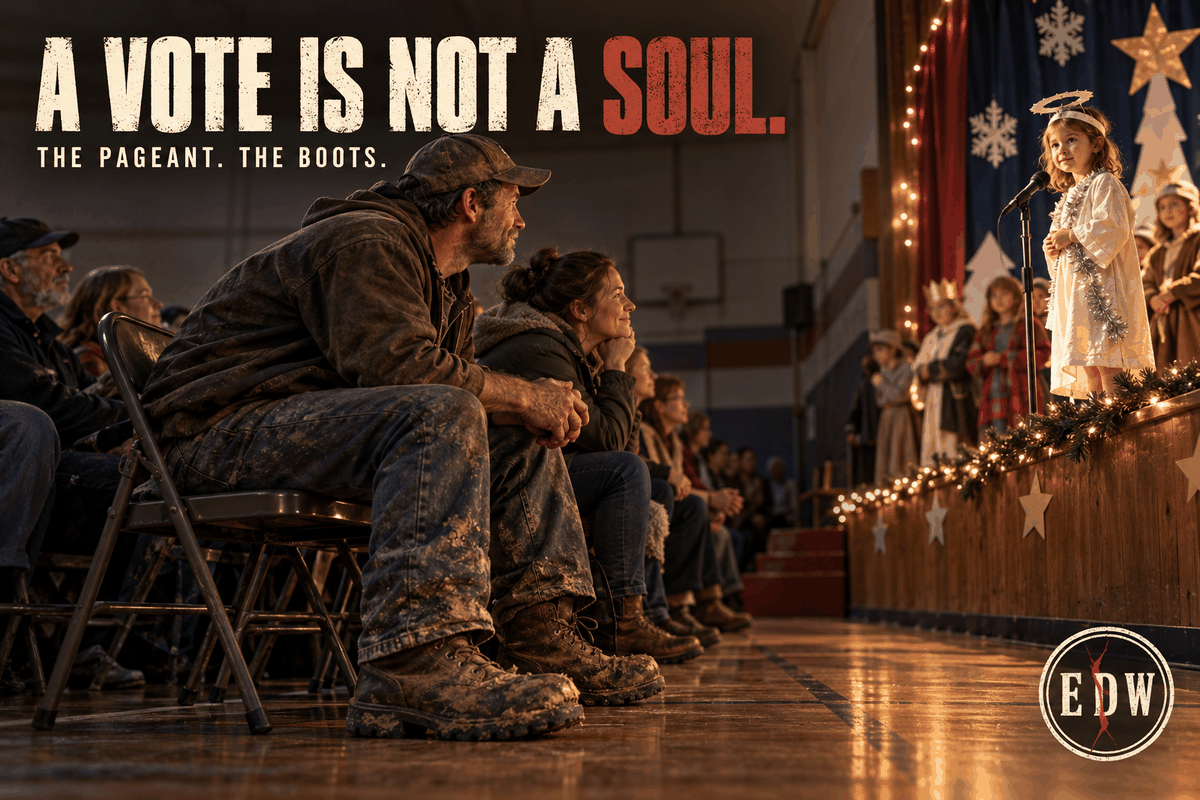
Thursday night in Athena-Weston, in a grammar-school gym that smelled like winter coats and stale coffee, I watched kids shuffle across a stage in paper halos and tinsel. The singing was off. The cues were missed. A kid froze and then remembered their line at the last second. Parents laughed softly, because it’s not a performance, it’s a proof of life. And because I’m an author and because I can’t help it, I didn’t only watch the kids. I watched the room.
Work boots. Callused hands. Dirt under fingernails that didn’t quite wash off. People who didn’t look “tired.” They looked exhausted. The kind of exhaustion that comes from doing the actual work that keeps a place running and still showing up for your kid in the third row because that’s what you do. You show up.
Athena-Weston, small town America. If you’ve spent time there, if you’ve read the local forums, you know the political odds. A lot of those people likely voted for Trump.
And I’m going to say this as plainly as I can, because I mean it and because I’m done pretending it’s complicated:
If I walk out of that gym and dismiss those people as bad people, I’m not building anything. I’m not building a coalition. I’m not building a country. I’m building a cage and calling it righteousness.
Here’s why it hits me so hard: Athena isn’t an abstract place to me. It’s chosen family.
I have kids in my life there, kids who aren’t “my family” on paper, but I was the first person to hold them. I’ve fed them, rocked them, watched them grow into little humans with jokes and opinions and the same stubbornness I recognize in myself. I have children of Republican voters who talk like me, act like me, tease like me. They feel like mine because love doesn’t ask for voter registration.
So when people talk like half the country is garbage, it doesn’t land as politics. It lands as personal. It lands like someone spitting on the people I love and calling it moral clarity.
And I need to own my side of this, too, because I’m not innocent.
This war has cost me dearly.
It has taken relationships that should have been unbreakable (people who were part of my tribe my whole life) until the madness started in 2016. Maybe it started earlier, but that’s when it got loud for me, when everything became a loyalty test and every conversation turned into a battlefield.
I’ve lost friends. I’ve lost family. I’ve lost the simple comfort of knowing we could disagree and still belong to each other.
And for a while, I did what everybody does when they’re hurt: I picked a story that made the pain feel noble. I told myself it was because the other side had become “bad,” and I was just responding to reality.
But the truth is uglier.
The algorithm got me.
Not because I’m stupid. Because I’m human.
I can blame the feed all day, but if I’m honest, the feed didn’t invent my instincts. It just learned them. It learned what makes me feel righteous. It learned what makes me feel attacked. It learned what makes me feel superior. It learned what makes me feel afraid. Then it served me a version of the world that fit me, not a version that was necessarily true.
And here’s the part that matters: it’s doing that to them, too.
Those exhausted parents in that gym don’t live in an “information marketplace.” They live in an information community. Media, friends, family, church, the cues of belonging that tell you who’s with you and who’s against you. And every time someone sneers at “Trump voters,” every time somebody on my side talks like rural people are dumb or backwards or disposable, it gets replayed to them until it becomes a fact in their bones: They hate us. They look down on us. They think we’re idiots.
Then we wonder why they retreat deeper into the tribe that promises protection.
That doesn’t make them evil.
It makes them human, responding to incentives we pretend don’t exist, while we’re being shaped by the same incentives and calling it “being informed.”
So I’m drawing a line for myself, right here, in public, because I can’t keep living in the lie:
A vote is not a soul.
Who you voted for tells me something. It doesn’t tell me everything. It doesn’t tell me whether you show up for your kid. It doesn’t tell me whether you help your neighbor. It doesn’t tell me whether you’re a decent person trying to hold a life together in a country that feels like it’s falling apart.
And if I have to reduce you to a caricature to feel morally clean, that’s not morality. That’s addiction.
This is where I want to hammer it home, because I’ve learned it the hard way: if I can’t tolerate being wrong, I will never get meaningfully true.
I have to be willing (vigorous, relentless, sometimes humiliatingly willing) to admit I’m wrong. To change my mind. To slow down. To say “I don’t know.” To ask, “What would prove my favorite story false?” To sit with the discomfort of complexity instead of grabbing the nearest villain and calling it clarity.
Because that, right there, is the only path out.
Not winning. Not dunking. Not purity.
Maturity.
We keep looking to leaders to fix this, but leaders respond to what we reward. And what we reward right now is the most radical, the most furious, the most shameless. We reward people who can keep us angry on purpose. Then we act shocked when morally vacant leadership rises like foam to the top.
We say we want honesty. But we keep clicking on outrage.
We say we want unity. But we keep applauding contempt.
We say we want truth. But we keep treating correction as humiliation.
So here’s what I want, what I need, for myself and for anyone who still believes this country can be more than a permanent blood feud:
Stop treating your neighbors like enemies.
Stop talking like half the country is irredeemable.
Stop confusing certainty with courage.
Start rewarding people (leaders and regular citizens) who can say:
“I was wrong.”
“I shared that too fast.”
“That felt good to believe, but I can’t prove it.”
“I’m listening.”
“I care about your dignity even when I disagree with you.”
Because I’m telling you: I’ve been in the gym. I’ve seen the boots and the tired faces and the pride and the love. I’ve held the babies who grew up into kids who feel like mine. And I refuse to let politics turn them into villains in my mouth.
If we want a country that stops protecting morally vacant leadership, we have to become a public that can’t be bought with rage. A public that can’t be owned by the algorithm. A public that doesn’t require the other side to be subhuman in order to feel human.
That begins with one brutal, simple discipline:
Tell the truth, even when it costs you the comfort of your tribe.
EDW•