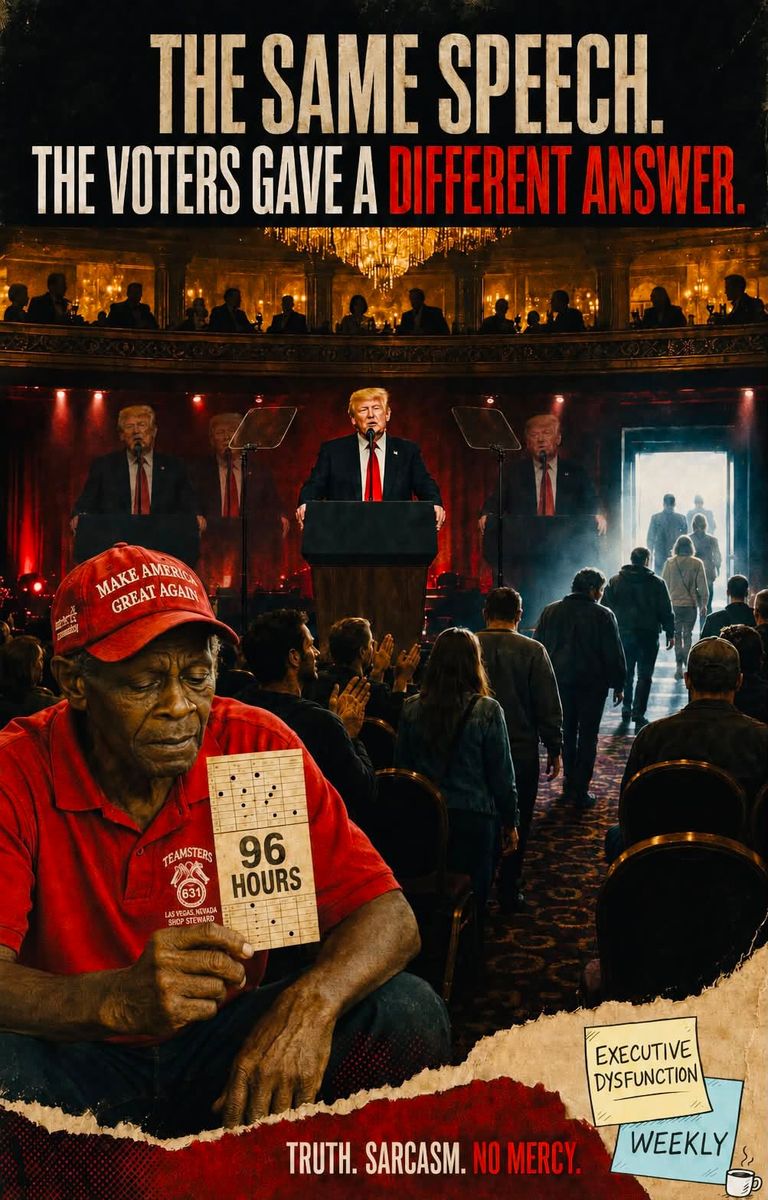
The rally kept applauding. Parts of the country may be quietly leaving the room.
I watched Donald Trump’s entire Nevada speech.
The whole damn thing: every boast, grievance, miracle, communist, billionaire roll call and little “Y.M.C.A.” fist pump at the end.
I was trapped inside the longest rerun in American television history.
Trump spoke as though Venezuela’s oil were an American prize of war. He celebrated destroying boats suspected of carrying drugs instead of arresting the people aboard and bringing them to trial. He fantasized about firing judges who displease him, mocked defense lawyers and due process, and treated election rules as legitimate only when they make Republican victory more likely.
The speech was the same. The permissions were worse.
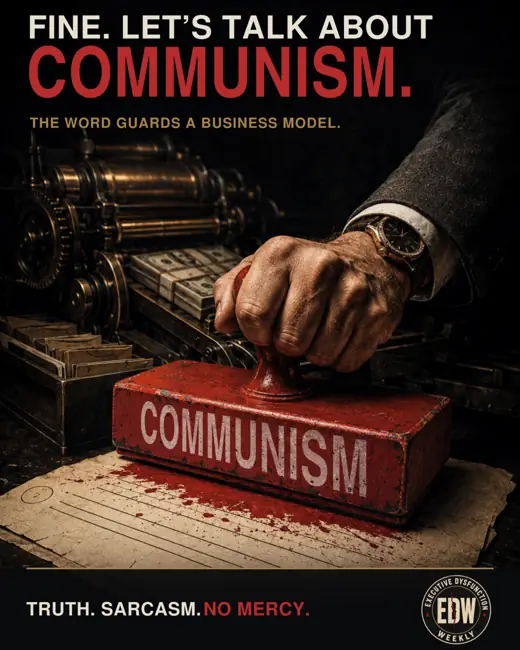
Every success was the greatest achievement in history and had been personally created by Donald Trump. Every failure had been inherited. Every favorable number was rounded upward until it reached heaven. Every unfavorable number was fake. Every critic was deranged. Every Democrat was a socialist, every socialist was a communist, and communism was apparently more dangerous than Pearl Harbor, September 11, World War I and World War II.
Democrats, we were told, want to legalize heroin, ban gasoline, abolish Thanksgiving, pack the Supreme Court with 23 justices, give voting rights to tens of millions of undocumented immigrants and turn America into Venezuela, possibly before breakfast.
Meanwhile, America is already enjoying its greatest golden age.
Please do not ask how both things can be true. The contradiction is structural.
This is not policy. It is emotional maintenance.
The audience is given the same three comforts on an endless loop: you were right, your enemies are evil, and only one man stands between you and annihilation.
That worked extraordinarily well for a very long time.
But something is changing.
They Accidentally Staged the Entire Economy
The most revealing moment of the Nevada event was not one of Trump’s lies. It was a sequence in which nearly everybody may have been telling the truth.
Trump introduced Curtis King, a Teamsters Local 631 foreman. According to Trump, King works 96 hours a week and earns roughly 65 percent of his income from overtime. King explained that the new overtime tax provision had helped him recover financially during a divorce and buy a house.
Good. Working people deserve the relief.
Now stop applauding long enough to look at the number.
A week contains 168 hours. After 96 hours of work, 72 remain. If King sleeps seven hours a night, that leaves 23 hours for every commute, meal, shower, errand, appointment, relationship and private thought he is permitted to have all week.
That is a human life being fed into a time clock.
Then Nevada Governor Joe Lombardo defended Trump’s billionaire friends. His argument was that billionaires create jobs and therefore must be taken care of.
Then Trump lovingly introduced casino billionaires Frank and Lorenzo Fertitta and Phil Ruffin. They were amazing. Loaded. Successful. Their families were beautiful and perfect.
They accidentally staged the entire American economy in about ten minutes.
The worker is celebrated because he survives 96 hours of labor. The billionaires are celebrated because they own the building. Government’s great contribution is to tax a little less of the worker’s exhaustion, then market the exhaustion itself as proof that the system works.
No.
The tax relief may be good. Working 96 hours a week is still an indictment.
Taxing exhaustion less does not give the worker his life back.
The Applause Said One Thing. The Ballots Said Another.
While Trump was delivering the same speech, voters were beginning to supply a different answer.
In Michigan’s 8th Congressional District, Amir Hassan, the candidate Trump endorsed, lost the Republican primary by roughly 17 points to Thomas Smith. Smith had suspended his campaign weeks earlier and endorsed someone else. He was not merely underfunded. He had effectively left the race.
The candidate who quit beat the candidate Trump told Republican voters to choose, about 50 percent to 33 percent.
That is objectively hilarious. It is also politically meaningful.
We should not inflate one result into a national religious conversion. John James, another candidate backed by Trump, won Michigan’s Republican gubernatorial primary. Trump’s endorsement still carries enormous power with much of the Republican base. Millions of voters remain fiercely loyal to him.
But a dormant campaign humiliating Trump’s chosen candidate in a competitive district is not nothing. It is what political fatigue looks like when it reaches the ballot.
The wider evidence points in the same direction.
Pew Research Center found that 70 percent of voters who lean Democratic say control of Congress really matters this year, compared with 60 percent of voters who lean Republican. Among Democrats, 39 percent have thought a lot about the midterms. Among Republicans, only 22 percent have. Half of voters in the Republican coalition say Trump is not much of a factor in their congressional vote, while 44 percent describe their vote as one for him.
That last number matters. Trump still motivates a huge share of Republicans. He simply no longer appears to motivate enough of them with the same intensity.
A conservative organization affiliated with Charles Koch reached an even harsher conclusion. Americans for Prosperity Action says roughly one in five normally reliable Republican voters it studied across six important states may stay home or consider voting Democratic. Their central complaints were not sudden affection for liberalism. They were inflation, prices and unfulfilled promises.
The latest Reuters/Ipsos poll put Trump’s approval at 35 percent. It also found that voters preferred Democrats over Republicans on managing the economy, 37 percent to 36 percent, the first Democratic advantage in that survey’s series in nearly a decade. On the generic congressional ballot, Democrats led 42 percent to 37 percent.
The direction is unmistakable.
Even Voters in Red States Have Limits
Kansas and Missouri delivered another warning.
Kansas voters rejected an effort backed by Republicans to replace the state’s judicial selection system with direct Supreme Court elections, 61 percent to 39 percent. Opponents warned that the proposal would turn the court into another campaign money auction.
Kansans agreed.
In Missouri, roughly 80 percent of voters rejected a plan that would have made constitutional amendments proposed by citizens vastly harder to pass. About 83 percent rejected eliminating the state income tax without a credible way to replace the revenue, a proposal that opened the door to broader sales taxes and raised obvious questions about funding schools and other public services.
These results do not prove a blue wave. They prove something more useful: voters in deeply Republican states can recognize overreach when it is placed plainly in front of them.
In Michigan’s Democratic Senate primary, voters also chose Abdul El-Sayed, the man Trump repeatedly called a communist and “full of shit.” El-Sayed ran on a message concise enough to fit on a bumper sticker:
Money out of politics. Money in your pocket. Medicare for All.
Across both parties’ Michigan Senate primaries, AdImpact had tracked $98.2 million in advertising spending and reservations as of July 31. Outside groups accounted for 88 percent of the spending on the Democratic side. Haley Stevens received $60.5 million in advertising support from outside groups. El-Sayed received only $7.5 million in total advertising support.
El-Sayed won.
That result landed at precisely the wrong moment for Trump.
He stood in a casino ballroom surrounded by billionaires, called the opponent of concentrated money a communist, and displayed a man working 96 hours a week as proof that prosperity had arrived.
Trump fatigue creates an opening. It does not build the bridge.
The bridge has to be made from material people can actually use: lower housing costs, affordable healthcare, stronger wages, protection for workers, less war, competent government and a political system that is not openly owned by a handful of human dragons.
Republican voters do not have to become Democrats for Trumpism to lose. Enough of them only have to stop believing that the same speech will produce a different life.
Their grocery receipts are rebuttals now. Their rent is a rebuttal. Working 96 hours a week is a rebuttal. Another war after promises of peace is a rebuttal. A candidate endorsed by Trump losing to a man who stopped campaigning is a punchline with a vote total attached.
The old performance still has power. The authoritarianism inside it is more dangerous, not less. But the magic trick depends on the audience looking where the magician points.
Some of them are beginning to look at their own lives instead.
The danger to Trump is not that Republican voters have fallen in love with Democrats.
It is that some of them are too tired to fall in love with the same speech again.
Executive Dysfunction Weekly
Truth. Sarcasm. No Mercy.
EDW•