I’m going to say it plainly: if the president’s answer to a question about warning allies before attacking Iran is a Pearl Harbor joke, that is not a joke. That is a diplomatic self own, a moral dodge, and an insult that lands on multiple levels at once.
It is also a confession.
The Japanese reporter asked why allies were not notified. That raises a broader question any serious ally asks in a rules-based alliance. Why were we not consulted before you took an action that predictably raises the risk of retaliation, economic shock, and widening conflict. That complaint is not unique to Japan. Leaders of NATO member countries and EU officials have already been publicly blunt that this was a war they were not consulted about and therefore not eager to join.
So what does a serious answer look like?
It looks like: here is what we assessed, here is what made it urgent, here is the legal basis, here is why consultation was not possible, here is what we need from allies now, here is how we avoid dragging you into it.
Instead, we got Pearl Harbor.
That is not explanation. That is substitution.
When a leader can’t or won’t answer the real question, he reaches for a line that changes the subject and changes the emotional temperature. Pearl Harbor is a historical trauma and a national scar for Americans. Using it as a snappy retort to a Japanese reporter is not “tough.” It is cheap.
It also poisons the room you are standing in.
Japan is not an audience you can heckle. It is a treaty ally that hosts American forces, relies heavily on Middle East energy routes, and is currently being pressured by the United States to provide support in the Strait of Hormuz despite major constitutional and political constraints.
And this is the moment the president chose to remind them, on camera, that their country once did a surprise attack in 1941.
This is how you create resentment in allied capitals. Not by disagreeing. By humiliating.
It gets worse when you take the remark seriously, because it is not merely offensive. It is strategically incoherent.
The president is being criticized for not consulting allies before a first strike. His defense, apparently, is that surprise is the point. That is what the Pearl Harbor reference signals. It says: yes, we struck without warning. Surprise is how this works. Get over it.
If that is the defense, then stop asking allies to treat this like a disciplined coalition operation. Coalitions run on consultation. They run on predictability. They run on trust and process, not on “gotcha” history.
You cannot have it both ways.
You cannot treat allies like they are obligated to help clean up a mess they were not allowed to see being made, and then mock them when they ask why they were not consulted.
And there is another layer, and it is the one that should set off alarms in the White House itself.
Pearl Harbor is the most famous example in American memory of a surprise strike while diplomacy and negotiation were still part of the public posture. It is exactly the analogy you do not want floating around if you are already being criticized for striking Iran while the diplomatic process was still ongoing and then calling it necessity.
So when the president invokes Pearl Harbor as a rhetorical weapon, he risks weakening his own defense. He hands his critics an easy sentence.
You want to talk about surprise attacks. Fine. Let’s talk about surprise attacks.
That is not where you want the debate.
You also do not want to normalize the idea that it is acceptable for heads of state to sling World War II trauma at each other as banter. That is how you roll back decades of careful alliance maintenance in one soundbite.
This is not new behavior, either. Trump has a history of Pearl Harbor references in Japan contexts, including reporting in 2018 that he told Shinzo Abe, “I remember Pearl Harbor,” an account Abe later denied. Even then, the core issue was not that Americans “can’t mention history.” It was that presidents do not use history like a cudgel in alliances that require trust.
There is a deeper irony here, too.
The same administration has been demanding that allies do more, pay more, send ships, send help, police the strait, carry weight.
Then, when an ally asks the most basic alliance question, why were we not consulted, the answer is essentially: you of all people should understand surprise.
That is not leadership. That is impulse control failure dressed up as swagger.
And this is why the remark matters beyond the insult.
It reveals a governing style that treats diplomacy like a dominance performance. Allies are praised when compliant and scolded when inconvenient. Questions are not answered, they are deflected. Accountability is not provided, it is substituted with a punchline.
If you want to know what Chancellor Merz was thinking in his own Oval Office appearance earlier, imagine what Prime Minister Takaichi is thinking now.
Not “this is strong.” Not “this is reassuring.”
More likely: this is volatile, and we need to protect our interests around it.
If the White House wants to clean this up, there is a simple path.
Publish the transcript. Own the remark or correct it. Explain, in plain English, why allies were not consulted and what was known at the time. Then stop using historical tragedy as a rhetorical grenade.
A president can be firm without being reckless. A nation can be strong without being humiliating. And a war can be explained without turning diplomacy into a stand-up routine.
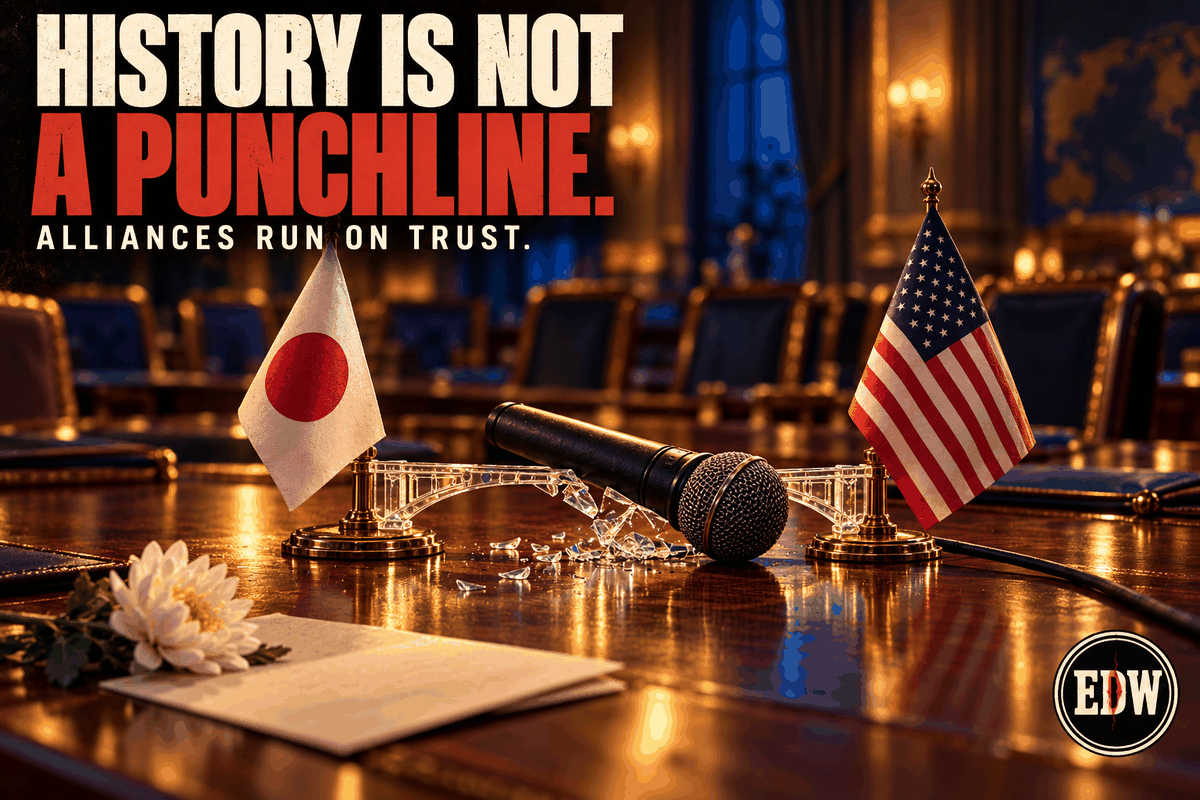
Pearl Harbor is not a punchline.
And if this is how we answer allies in public, we should not be surprised when they start answering us with distance.
EDW•