Today we celebrate Dr. Martin Luther King Jr. And I want to say this plainly: if our tribute is just a meme, a tidy quote graphic, and a quick “amen,” then we’re missing the point.
Because MLK wasn’t a “feel-good” figure. He was a disciplined leader who told the truth when it was risky, insisted on nonviolence when anger was justified, and demanded accountability when “go along to get along” was the easiest option.
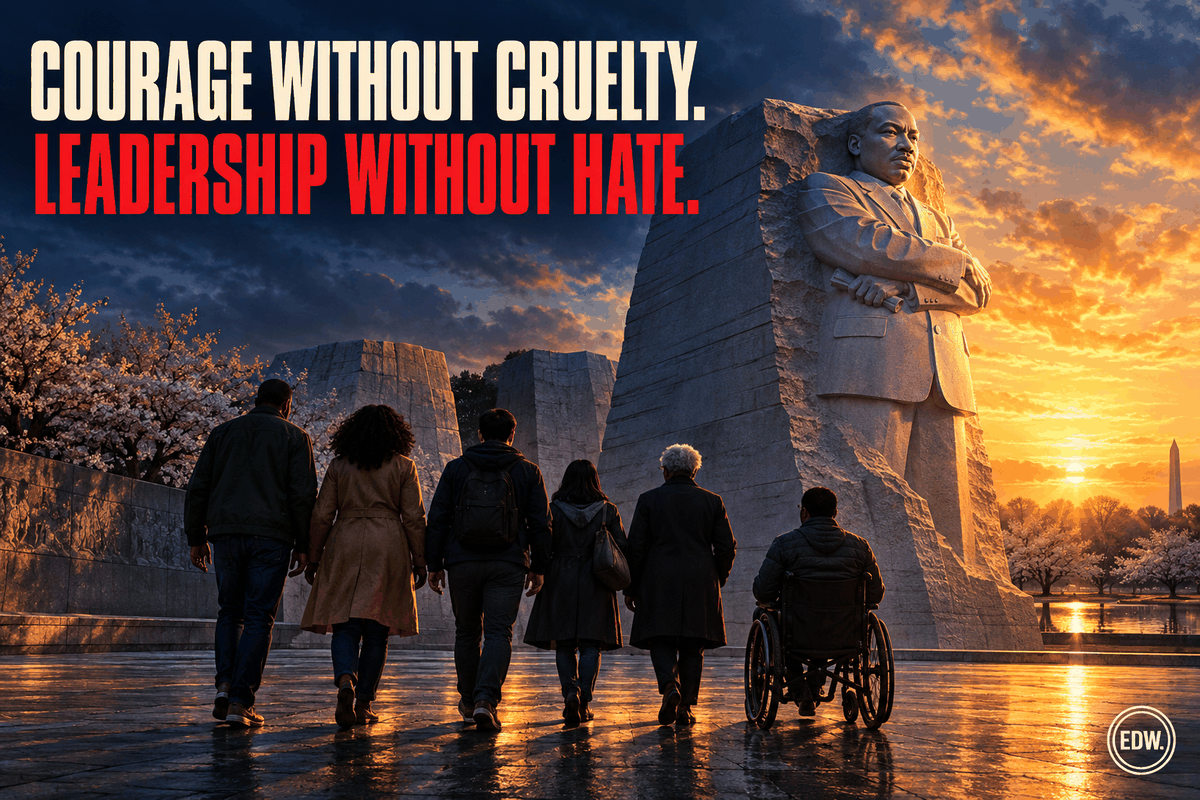
That, right there, is leadership. Integrity. Courage without cruelty.
And then I look at what passes for leadership right now, on BOTH sides, and it’s hard not to notice the gap.
Here’s what we’re being trained to accept as “normal” political speech:
• Name-calling as argument.
• Diagnosis as debate (“deranged,” “crazy,” “insane”) instead of evidence.
• Team loyalty as morality.
• Certainty as a personality trait.
• Winning as the goal, even if it requires lying, twisting, or dehumanizing.
Let me give a few recent, concrete examples of the kind of rhetoric I’m talking about, NOT to “gotcha” one party, but to show the pattern:
1) Insults instead of arguments
We have political leaders using language like “crooked officials,” “stupid,” “corrupt,” and treating that as if it’s proof of anything. That’s not persuasion. That’s contempt dressed up as confidence.
2) “Derangement syndrome” politics (on both sides)
We now have elected officials and political operations throwing around terms like “Trump Derangement Syndrome” or “California Derangement Syndrome” as a way to dismiss criticism without having to address it.
Think about what that does: it reframes disagreement as illness. It tells people: “Don’t listen to them; they’re not rational humans. They’re a diagnosis.”
That is a shortcut around thinking. It is also gasoline on social division.
3) Escalation as a business model
When the reward system is outrage, when donors, algorithms, and cable-news incentives all pay more for anger than for accuracy, we get leaders who perform for applause instead of leading for outcomes.
MLK’s leadership was the opposite of that.
He wasn’t “soft.” He was disciplined.
He insisted that methods matter. That truth matters. That how we treat human beings matters, even the ones we’re furious with.
One of the most famous lines associated with King is:
“Injustice anywhere is a threat to justice everywhere.” That’s not a partisan slogan. It’s a moral principle. It’s a reminder that society is interconnected, what we normalize against “them” eventually gets used against “us.”
And here’s another line engraved at the MLK Memorial that I keep coming back to: “Darkness cannot drive out darkness… Hate cannot drive out hate… only love can do that.”
People love to quote that like it’s sentimental. It isn’t. It’s strategic. It’s a refusal to become what you’re fighting.
In his Nobel acceptance speech, King talked about refusing despair, refusing the idea that our present reality is all we’ll ever be. That’s not naïve optimism. That’s leadership: a commitment to a better standard, even when it’s inconvenient.
So here’s my MLK Day challenge, to conservatives, liberals, independents, and the exhausted people who don’t fit neatly anywhere:
If you want to honor Martin Luther King Jr., don’t just repost him.
Practice him.
Try these standards for a week:
1) Stop mistaking insults for evidence.
If the “argument” is a nickname or a character attack, it’s not an argument. Ask: What’s the claim? What’s the proof?
2) Refuse the “derangement syndrome” frame.
Disagreement isn’t a diagnosis. If someone is wrong, show why, don’t pathologize them.
3) Demand intellectual honesty from your own team first.
If you only fact-check the “other side,” you’re not a truth-seeker. You’re a loyalist.
4) Separate policy disagreement from human worth.
You can be hard on policies and still treat people as human beings.
5) Choose courage over performance.
It’s easy to perform outrage. It’s harder to have a real conversation, admit uncertainty, update your view, and stay respectful.
And if you’re reading this thinking “but the other side started it”. I hear you.
Now ask yourself: Is that leadership? Or is that revenge?
MLK didn’t build a movement by convincing people they were perfect. He built a movement by calling people to be better than their worst impulses.
So I’m asking: what’s ONE belief you’ve updated in the last year?
One issue where you don’t match your party?
One time you admitted you were wrong and learned something?
Drop it in the comments. Not as a confession, as a flex. Because changing your mind based on new evidence is not weakness. It’s maturity.
If you want more posts like this, less tribal dopamine, more logic, more integrity, follow our page and share this. I’m not here to “win.” I’m here to rebuild the habit of thinking and arguing in good faith.
That’s not left.
That’s not right.
That’s a functioning country.