The Golden Age of Gullibility
America is facing a critical thinking crisis, and it’s not a pretty picture. In the land of free speech and 24/7 media, it seems we’ve stopped thinking critically about what we hear. Instead, we gobble up feel-good fiction and outrageous claims served by pundits and politicians as if they were prime-time entertainment.
The result?
A golden age of gullibility. Politicians make absurd statements and millions nod along, scarcely batting an eye. When a public figure can proclaim “the golden age of America has most definitely begun” while touting mass deportations of “illegal alien rapists, gang members, and suspected terrorists” and the crowd cheers, you know critical thinking is on life support.
How did we get here?
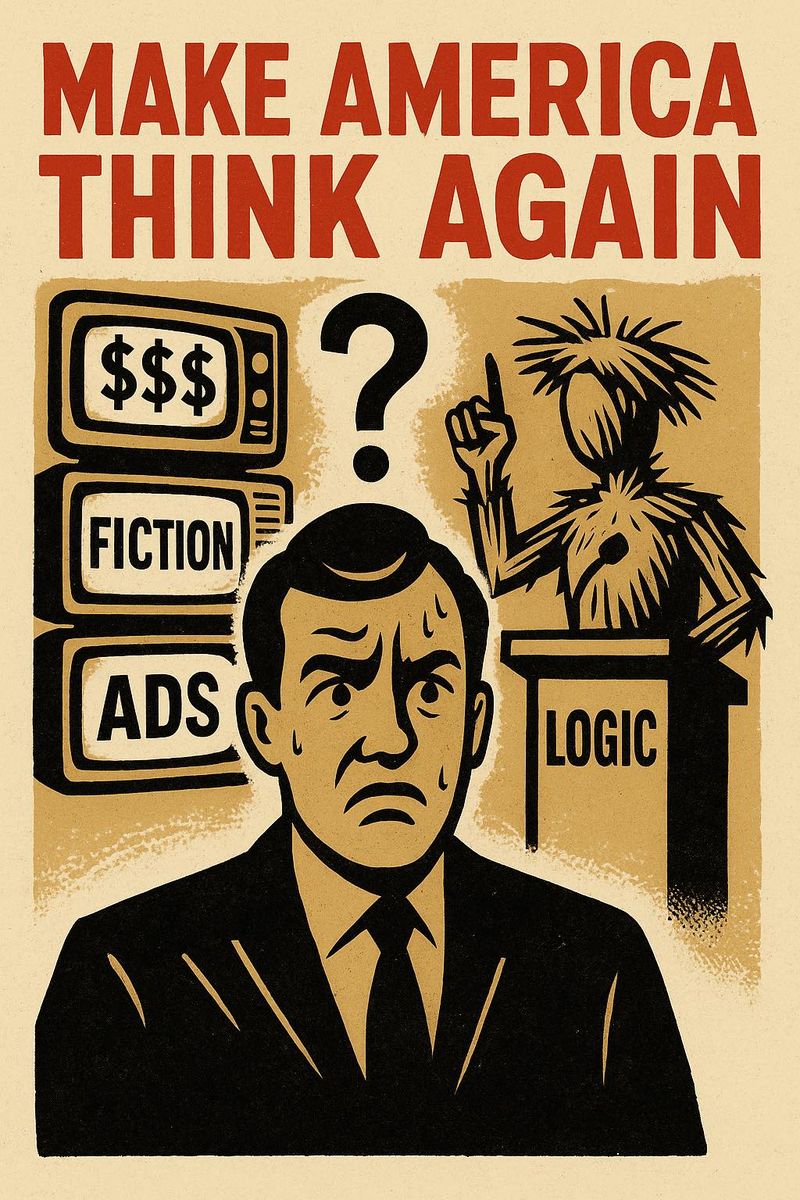
Blame the usual suspects: television, fiction, advertising, and an education system stuck in the past. We’ve been amusing ourselves to death with endless entertainment and persuasive messaging that dull our capacity for logic and healthy skepticism.
The average American watches hours of TV a day, bombarded by emotionally-charged stories and flashy ads. Our schools, meanwhile, churn out students adept at reciting the Preamble but ill-equipped to spot a logical fallacy in a political speech.
It’s a perfect storm for the death of discernment.
Brainwashed by the Screen: TV, Fiction, and Advertising
Let’s start with our screen addiction.
Decades of television have trained us to expect that every problem has a 30-minute solution (with commercial breaks). News is packaged as drama, complete with theme music and shouting matches, more to entertain than inform.
Fictional narratives, from political dramas to dystopian thrillers, blur into our reality, shaping what feels true even when it’s not. In fact, stories are powerful tools for belief formation because they engage emotion and reduce critical thinking .
Our brains don’t always separate fiction from fact; when a storyline “rings true” and plays on our fears, it can stick in our minds as pseudo-evidence .
Case in point: media psychologist Pamela Rutledge’s June 2, 2025 essay described a commenter who dismissed real research by saying, “You just need to watch Adolescence. That show tells you everything you need to know.”
This commenter might as well have said Gilligan’s Island taught them about maritime navigation.
Satirical as that sounds, it highlights a real problem: we trust compelling stories over complex facts.
Then there’s advertising, the art of making us want things by bypassing logic altogether.
Ad men and marketers have long known that repetition breeds belief. Psychologists even have a name for it: the illusory truth effect, where repeated exposure to false information can lead individuals to believe it’s true .
Hear a catchy slogan or a political soundbite enough times, and it lodges in your brain uninvited. (“Build the wall,” anyone?)
Advertisers don’t appeal to your reason; they appeal to your emotions: desire, fear, FOMO, you name it. Over time, a steady diet of “Act now! Don’t miss out!”
conditions us to respond to emotion over evidence.
We become suckers for punchy one-liners and easy answers, even in public affairs. Is it any wonder a sizable chunk of the population falls for conspiracy theories that are essentially political infomercials?
In short, television taught us to expect spectacle, fiction taught us to blur fact and fantasy, and advertising taught us to follow feelings over facts. Those are bad tutors for democracy.
Education: Stuck in Yesterday’s World
One place that was supposed to inoculate us against nonsense (our education system) has sadly lagged behind.
We’re using a 20th-century curriculum for a 21st-century reality.
Sure, students still learn the three branches of government and maybe read 1984 in English class (with any luck grasping its warning about propaganda).
But where are the lessons on spotting a Twitter bot peddling fake news?
Where is the mandatory training in logic and rhetoric that might help a future voter tell the difference between a sound argument and a fallacious one?
It’s largely absent.
High schoolers might graduate knowing how to solve a quadratic equation, yet remain baffled by a basic logical fallacy. We teach kids how to dissect a frog in biology, but not how to dissect an argument on cable news.
The result is an electorate easily swayed by emotional appeal and straw-man arguments, because nobody taught them how to call out the BS. Civics education, where it exists, teaches how a bill becomes a law, but not how a lie becomes believed.
It’s as if we assumed that critical thinking would just sprout naturally in the information age.
Spoiler: it hasn’t.
Instead, technological advancement has left the public overwhelmed with information and vulnerable to manipulation, while our schools stick to outdated lesson plans. Until we update our approach, handing a kid a smartphone without media literacy is like giving a teenager keys to a Formula 1 race car without driving lessons.
Crash incoming.
Leaders or Illusionists? Fallacy as Political Sport
Of course, this decline in critical thinking doesn’t happen in a vacuum. It’s eagerly exploited by political leaders who have discovered that they can say practically anything and get away with it, if they push the right emotional buttons.
American public discourse now often sounds like a contest in logical gymnastics, with gold medals for straw men, ad hominems, false dilemmas, and slippery slopes.
Let’s call these out brutally and by name:
• Straw Man: Perhaps the most popular fallacy on the stump. Why engage with your opponent’s actual position when you can misrepresent it as something crazy and knock that down instead?
President Donald Trump provides a masterclass.
In one presidential debate, when discussing climate policy, he veered off into a wild tangent about the Green New Deal: “He’s talking about the Green New Deal… It’s $100 trillion… where they want to rip down buildings… where airplanes are out of business… where they want to take out the cows too.” . Yes, you read that right: outlawing airplanes and cows. This is a textbook straw man argument – a deliberate exaggeration and distortion of environmental proposals to make them sound ludicrous. Joe Biden had to flatly reply, “Not true,” multiple times as Trump knocked down this absurd straw man. By the time fact-checkers could explain that no, nobody is coming for Betsy the cow, the damage was done. The audience had heard a vivid (if false) picture of extremist tree-huggers. It’s easier to scare people with “they want to take your hamburgers!” than to address the nuanced truth of climate policy.
• Ad Hominem: Why debate ideas when you can just attack the person?
This fallacy is alive and well at the highest levels. We’ve heard it from Trump a thousand times: opponents are “crazy,” journalists are “stupid,” anyone challenging him is “nasty.” During an official press event, when NBC’s Peter Alexander asked a tough question, Trump’s response was to lash out: “You are a terrible reporter… You don’t have what it takes… You’re not smart enough… you’re a disgrace. No more questions from you.” .
This ad hominem attack didn’t answer the question at all; it simply insulted and attempted to discredit the questioner.
It’s playground stuff: “you’re dumb, so your question doesn’t count.”
But in the current climate, this brazen tactic gets cheers from supporters who have been primed to distrust the press. Instead of expecting leaders to address an issue, a chunk of the public now revels in the spectacle of bullying.
Critical thinking would tell you that attacking the messenger is not an answer, but critical thinking has left the building.
• False Dichotomy & Slippery Slope: Another favorite: reduce every complex issue to a binary choice between heaven and hell, and warn that if you choose wrong, doom awaits.
Trump excelled at this too. In campaign speeches he liked to frame elections as a choice between paradise and apocalypse. “This election is a choice between the American Dream and a socialist nightmare,” he declared . There’s no room for nuance in that framing, just an implicit false dichotomy: you’re either for Trump (prosperity, all things good) or you’re ushering in the USSR 2.0. He coupled that with a slippery slope scare story: if Biden won, Trump claimed, “Biden will delay therapies, postpone the vaccine, prolong the pandemic, close your schools and shut down our country” . In reality, Biden had no such plan to indefinitely shut everything down, but the fear-mongering was the point.
Likewise, on healthcare policy, Trump argued, “the Democrat Party is pushing a socialist nightmare” and that their plans “would bankrupt our healthcare system, collapse our hospitals, and destroy Medicare” .
This cascade of catastrophe is pure slippery slope: take one step left, and apparently you free-fall into national ruin. Never mind that other developed countries manage to have broader healthcare without mass hospital collapses; the logic isn’t the point, the panic is.
By presenting Americans with a false “either/or” choice and then painting one side in nightmarish terms, politicians corral voters toward the desired option.
It’s intellectual blackmail: support me, or face certain doom.
And it works far too well on a populace untrained in calling out the false choices and extreme hypotheticals.
Even the new generation of political communicators is sticking to the old playbook of fallacies. White House Press Secretary Karoline Leavitt, barely out of college herself, now stands at the briefing podium spinning narratives that would make George Orwell facepalm.
She recently heralded budget cuts by triumphantly announcing “no more funding for illegal DEI programs… no more funding for the Green New Scam… no more funding for transgenderism and wokeness across our federal bureaucracy” .
In one breath she managed two straw men and an appeal to emotion. Labeling diversity initiatives as “illegal” and caricaturing the Green New Deal as the “Green New Scam” is meant to delegitimize those ideas without honestly debating their merits. And tossing in “transgenderism and wokeness” as bogeymen is just red meat for a base trained to react to those trigger words.
It’s all slogan, no substance – a logical fallacy fiesta.
Leavitt even had the audacity to claim from the podium, “It’s correcting the lies and the wrongs of the past four years, many of the lies that have been told to your faces in this very briefing room. I will not do that.” .
The irony is rich: accuse your predecessors of lying to make your own propaganda sound like truth.
It’s a savvy tactic for maintaining power in a post-truth era: disorient the audience so thoroughly that they doubt everything except the voice that shouts loudest.
Why We Fall for It: The Psychology of Misinformation
It’s easy to blame the liars and the nonsense peddlers, but we have to face an uncomfortable fact: we, the people, are often willing participants in our own deception. Psychology and cognitive science offer some clues as to why otherwise capable folks can’t distinguish truth from fiction after a constant media barrage.
First, humans are fundamentally emotional and social creatures, not cold rational robots.
We are wired to respond to stories and social cues. Constant exposure to media – whether it’s TV news, Facebook feeds, or talk radio – hijacks our instincts. Our attention is drawn to sensational headlines and emotionally-charged claims, because those provoke a stronger reaction (and reactions keep us glued to the screen).
Each time we react instead of reflect, our critical thinking muscle atrophies a little more.
Then there’s the echo chamber effect.
Thanks to algorithms and partisan media, many Americans live in customized information bubbles where their existing beliefs are constantly reinforced. Hearing only what we agree with creates a confirmation bias feedback loop. And when misinformation comes from a source that we identify with – say, a politician from “our” team or a TV commentator we like – we tend to swallow it without question.
As the American Psychological Association points out, people are more likely to believe misinformation if it comes from in-group sources rather than out-group ones, or if they judge the source as credible . In other words, if Uncle Bob or our favorite cable host repeats a whopper, we’ll consider it gospel; if the other side says the sky is blue, we suspect a trick.
Tribal loyalty tugs harder than truth.
Repetition itself is a potent drug.
We’ve mentioned the illusory truth effect – when a false claim is repeated often enough, it starts to feel true.
Now combine that with modern information overload.
Faced with a firehose of news, gossip, and memes, our brains often take a shortcut: if I’ve heard it multiple times, it must be legit. Politicians and advertisers exploit this by hammering simple talking points ad nauseam. Recall the endless chants and slogans – after the hundredth rally where “Lock her up!” echoes or the thousandth time you hear “fake news”, the words lose shock value and become part of the mental furniture. Familiarity breeds acceptance.
Constant exposure to certain ideas literally numbs our skepticism.
Psychologically, many Americans are also just exhausted. It’s hard work to verify facts and debunk lies, especially when new claims come at you nonstop. Researchers have noted a phenomenon dubbed “news fatigue” – people tuning out because they can’t distinguish fact from fiction amid the noise .
In that overwhelmed state, it’s tempting to just believe the narrative that feels right or is shouted the loudest. It’s mental shorthand: trust your gut, or your chosen guru, and ignore the rest. Unfortunately, those guts and gurus are often misleading.
Finally, there’s the dunning-kruger effect lurking in the background: the less people actually know, the more overconfident in their understanding they tend to be.
If you have an education system and media environment that never taught people how to recognize their own knowledge gaps, you end up with folks who think they know the truth and cling to false beliefs with absolute conviction.
They’ve never been taught to say “I might be wrong” or to demand evidence.
Every conspiracy theorist on the corner of the internet believes they’re the one seeing clearly while the rest of us are sheeple. Cognitive science tells us that once a false belief has taken root, it’s extremely hard to dislodge – corrections often bounce right off the armor of conviction .
We’re witnessing that in real time: no amount of fact-checking seems to shake the diehards who know what they know. This is the zombification of critical thought – minds that consume but don’t analyze, impervious to facts like the undead are to pain.
The Case for Mandatory Logic Class (No, Seriously)
So here we are, an advanced technological society with mass information at our fingertips and a populace that can hardly tell fact from fake. If this were a sci-fi story, the aliens would be laughing at us. But it’s real, and it’s dangerous to our democracy. What can we do (short of confiscating everyone’s TVs and phones)? The satirical answer – which might actually be the real answer – is to radically upgrade our education in logic and critical thinking.
It’s time to make Logic 101 as compulsory as English or Math in our schools.
Yes, I’m proposing a mandatory logic class for every student in America, preferably starting as early as middle school and reinforced through college.
We’ve tried adding civics back to curricula (and we should), but knowing how a bill becomes law won’t help if you can’t spot a slippery slope fallacy when a demagogue shouts one in your face. We need courses that cover the basic principles of reasoning, the common logical fallacies, how to evaluate evidence, and how to spot manipulative rhetoric. In this class, students would earn an A by correctly calling out a straw man in a debate clip, or identifying an ad hominem in a political ad, or explaining the difference between correlation and causation when some charlatan tries to sell them snake oil. The final exam could be to watch a presidential press briefing and write a report on all the logical fallacies and unsupported assertions spouted – talk about real-world skills!
Sound extreme?
Only because it’s so absent now. Once upon a time (think Ancient Greece), logic and rhetoric were core subjects for any educated citizen. We’ve relegated them to the nerdy realms of philosophy majors and debate clubs. That needs to change, fast.
A democracy can survive only if its citizens can discern argument from abuse, evidence from exaggeration.
Otherwise, we’re just a nation of easy marks, ripe for the next con man or the next mass hysteria. As Rutledge aptly put it, “we need to recognize our innate vulnerabilities to storytelling and start asking better questions” .
Exactly – and that recognition can be taught.
Imagine a generation of Americans who respond to a misleading viral meme not by hitting “Share,” but by saying “Hmm, is that really true? What’s the source? Are we sure that isn’t a false dilemma or some confirmation bias at work?”
Sounds utopian, but it’s possible.
We mandate driver’s education to prevent accidents; why not logic education to prevent civic wrecks? Let’s teach people that feeling something is true doesn’t make it true. Let’s immunize young minds against the seductions of charisma and the hypnosis of partisan media.
Frankly, a logic class might do more to safeguard this nation than a dozen laws and a hundred fact-checkers. It would create citizens who are their own fact-checkers.
In the meantime, for the rest of us out of school: we need a crash course in unlearning our bad mental habits. Turn off the TV once in a while and read an in-depth article (and yes, verify the author isn’t a paid shill).
When a piece of news makes you angry or elated, take a pause and ask why – is it pushing your buttons on purpose?
Check if that dramatic statistic or quote floating around social media has a citation (and no, “my friend’s screenshot” is not a citation). Challenge yourself to consume media outside your bubble and analyze arguments from the “other side” logically – you might be surprised which ones hold water and which collapse. It’s mental exercise for a flabby brain, and it’s as vital as physical exercise is for the body.
Our national discourse may always have some degree of nonsense – hyperbole and passion are part of politics, and snake oil salesmen will always slither about. But we don’t have to be such easy prey.
The decline of critical thinking in the U.S. is not irreversible if we choose to value truth over tribalism and education over indoctrination. Satire aside, a mandatory logic class (and a broader revival of critical thinking at all ages) could be the vaccine we need against the epidemic of gullibility.
It’s either that or keep watching the “United States of Amnesia” spiral downward, one flimflam and fallacy at a time.
The choice is ours – and unlike the false choices our politicians often foist on us, this one is pretty clear. Do we continue down the path of least resistance, letting television, fiction, and loud-mouthed leaders do our thinking for us?
Or do we buck the trend and demand logic, evidence, and intellectual accountability in our public sphere?
I, for one, vote for the latter.
It’s high time to Make America Think Again.
Because if we don’t, the next golden age we inaugurate might just be the golden age of the straw man – and that, dear readers, would truly be a nightmare of our own making.
EDW•