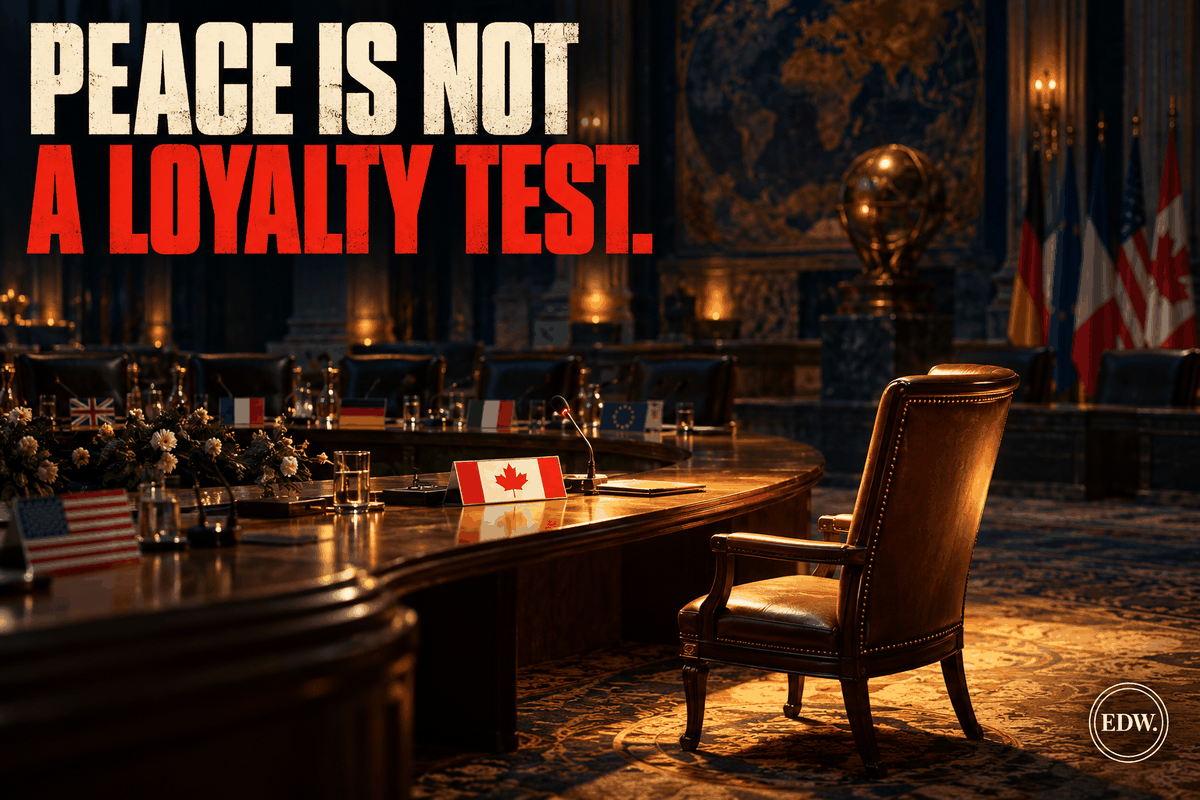
At Davos on January 20, 2026, Canada’s Prime Minister Mark Carney warned that the rules‑based order is fading, that “going along to get along” won’t buy safety, and that “middle powers must act together because if you are not at the table, you are on the menu.”
Two days later, on January 22, President Trump withdrew Canada’s invitation to join his new “Board of Peace.”
That sequence should stop every American in their tracks.
To our Canadian and European friends reading this: many of us in the U.S. value you as allies and partners. We do not want “peace” redefined as obedience, or alliance treated like a loyalty test.
The Board of Peace was sold as a mechanism to help lock in a Gaza ceasefire and coordinate reconstruction. The White House has pointed to U.N. backing, and the U.N. Security Council did welcome a “Board of Peace” concept as part of a Gaza transition framework.
But the structure now taking shape does not look like rules‑based peacekeeping. Publicly circulated charter language concentrates authority in a chairman, offers exemption from a three-year membership term for countries contributing more than $1 billion in the first year, and leaves membership vulnerable to political whim. Trump has publicly framed the body as something that, once formed, can do “pretty much whatever we want,” even as the U.N. has signaled its engagement is limited to the Gaza context.
Peace cannot be built on a system where allies are rewarded for compliance and punished for candor.
America is safest when our leadership is predictable, institutional, and anchored in law; when allies know our partnerships aren’t pay‑to‑play; and when sovereignty is treated as a boundary, not a bargaining chip.
If you want a strong America, demand a peace architecture that’s constrained by rules, not personalities.
If this mattered to you, please share it. Follow Executive Dysfunction Weekly (EDW) for evidence‑first breakdowns and good‑faith debate.
EDW•