The room told on itself.
Pete Hegseth opened with the kind of language that always makes war sound easy if you are standing far enough away from the blast zone. Victory. Courage. Resolve. History. Trump as the man who finally did what weaker presidents would not. The usual chestplate of adjectives polished to a shine.
Then General Dan Caine stepped in and the temperature changed. The words got heavier. The mission got more complicated. Risk entered the room. Logistics entered the room. Rescue entered the room. The shape of war looked less like a movie trailer and more like what it is when adults are forced to carry it.
Then Hegseth came back, and with him came the performance.
You could feel it.
The shift from burden to swagger. From duty to appetite. From briefing to spectacle.
But it was a moment from Hegseth’s opening remarks that I cannot get out of my head.
The dead roll.
Title. Dead.
Title. Dead.
Title. No longer with us.
Title. Dead.
He kept going. He kept staring into the camera. He cut the air with his hand as he read through the list, like he was carving certainty into the room. It landed with the rhythm of celebration. Not solemnity. Not gravity. Celebration.
And that is where something in me broke.
Yes, Iran’s regime has blood all over it. We know that. We know what they have done directly and through proxies. We know the terror, the murders, the bombings, the repression, the hostages, the roadside bombs, the generations of brutality. Nobody needs to launder that history for us.
But what are we becoming when this is how we sound?
That question sat in the room whether anyone wanted to say it or not.
Because Dan Caine sounded like a man entrusted with terrible tools. Pete Hegseth sounded like a man enjoying them.
You did not have to agree with every policy question in play to hear that difference. You did not have to be soft on Iran to hear that difference. You only had to have a pulse.
Caine talked like someone trying to move carefully through danger. Hegseth talked like someone trying to sell danger back to the public in a gift box.
The language gave it away. A “capital V military victory.” A ceasefire that is only a pause. Forces staying put. Forces ready to restart. Infrastructure held under threat. Bridges. Power plants. Export capacity. All of it hovering just offstage, ready to be taken if Iran misbehaves. Reuters’ coverage of the briefing matched that basic picture. Hegseth called it a decisive victory. Caine made clear the ceasefire is a pause and the military remains ready if diplomacy breaks down.
Listen to the moral vocabulary they are building for us.
A country’s electrical grid becomes leverage.
Its bridges become bargaining chips.
Its economy becomes a hostage.
And the decision not to erase those things, at least for the moment, gets called mercy.
Mercy.
What kind of mercy arrives with target packages locked and loaded?
What kind of peace keeps one hand wrapped around a throat and asks to be admired for not squeezing harder?
What kind of republic hears that and nods along like this is simply how serious people talk?
Those questions matter because this country is ours. The face these men present to the world is our face whether we like it or not. The voice they use in public becomes, for that moment, America’s voice.
Do you want that voice to sound like this?
Do you want it to sound thrilled with itself?
Do you want it to sound amused by dominance?
Do you want it to sound eager while reading through the dead?
Because that was the feeling in that room. Hegseth kept trying to wrap it in honor, strategy, metrics, providence, all the usual packaging. But underneath the wrapping paper was the same old thing. A man intoxicated by force, narrating power like it was the point rather than the burden.
And the burden is the point.
War asks for seriousness. It asks for adults. It asks for a vocabulary that can carry tragedy without getting high on it. It asks leaders to understand that every operation exists inside a moral world, not outside one. It asks them to remember that there are families attached to every body, history attached to every bomb, memory attached to every humiliation.
The military officer in that room sounded like he knew that.
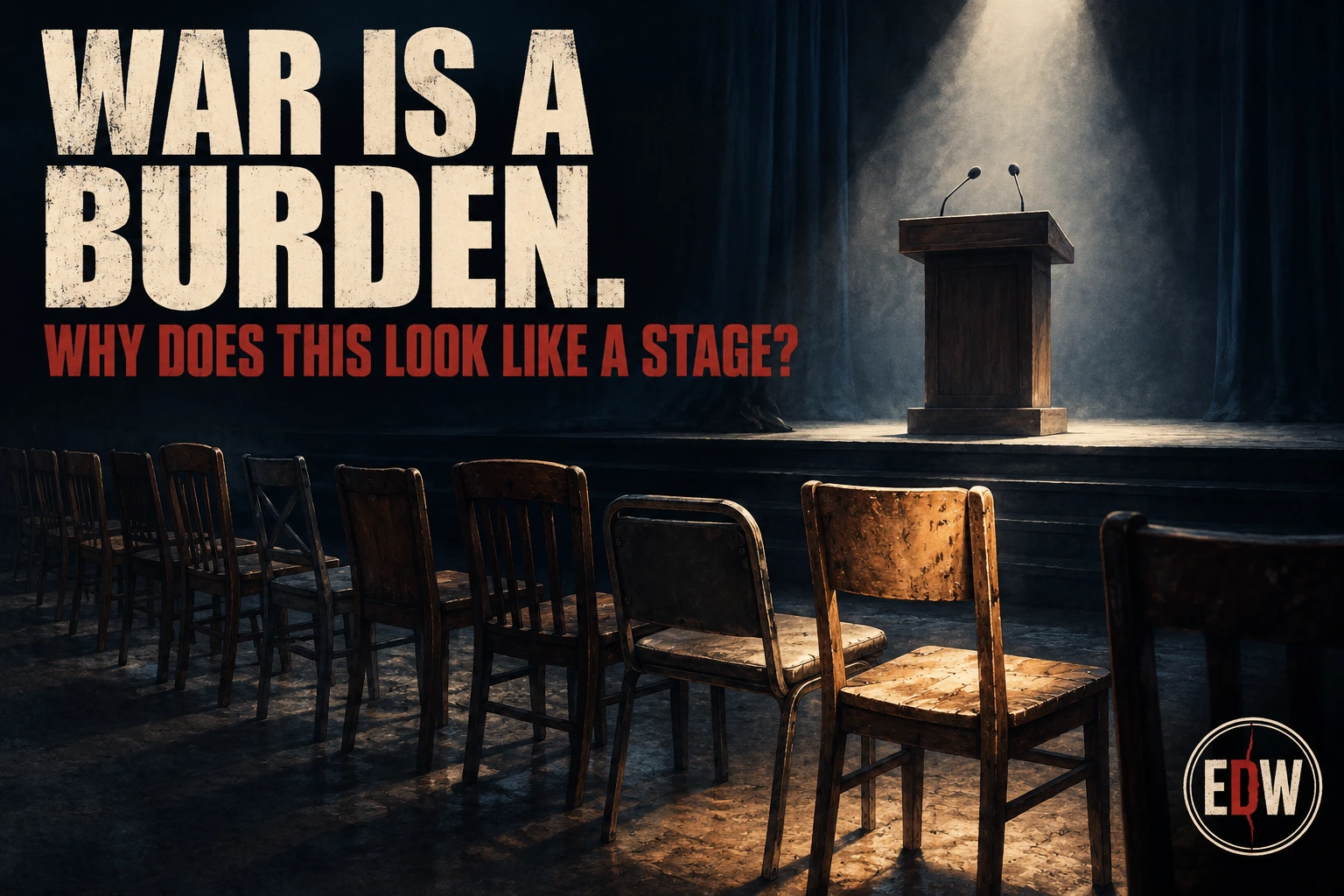
The politician sounded like he had found a stage.
That contrast should haunt people.
Because sooner or later every society gets asked the same question in some form. Not whether it can win. Not whether it can dominate. Not whether it can terrify. A stronger nation can usually do all of that.
The harder question is what it becomes while doing it.
At what point do we push back on the performance itself?
At what point do we say the framing is rotting us?
At what point do we refuse the seduction of the dead roll, the hand-slicing certainty, the grin hidden under the vocabulary of mission and greatness?
At what point do we say that public language like this drags the country somewhere ugly, even when the enemy is ugly too?
Because enemies do not decide who we are. We do.
And I keep coming back to that room. To the feeling of one man carrying war and another one staging it. To the way the dead were spoken into the air like points on a board. To the way so much of official Washington now seems to think Americans are hungry for domination theater and should be grateful when it comes with a flag pinned to its lapel.
Maybe some are.
But I do not believe they are all numb yet.
I think a lot of people heard what I heard. I think they felt the floor shift. I think they recognized, maybe only for a second, the gap between service and spectacle.
Hold onto that second.
That second is where conscience lives.
If this said what you felt but could not quite name, follow EDW, share it around, and pull a few more people into the conversation. The country still belongs to us, and so does the right to say what it should never sound like.
EDW•