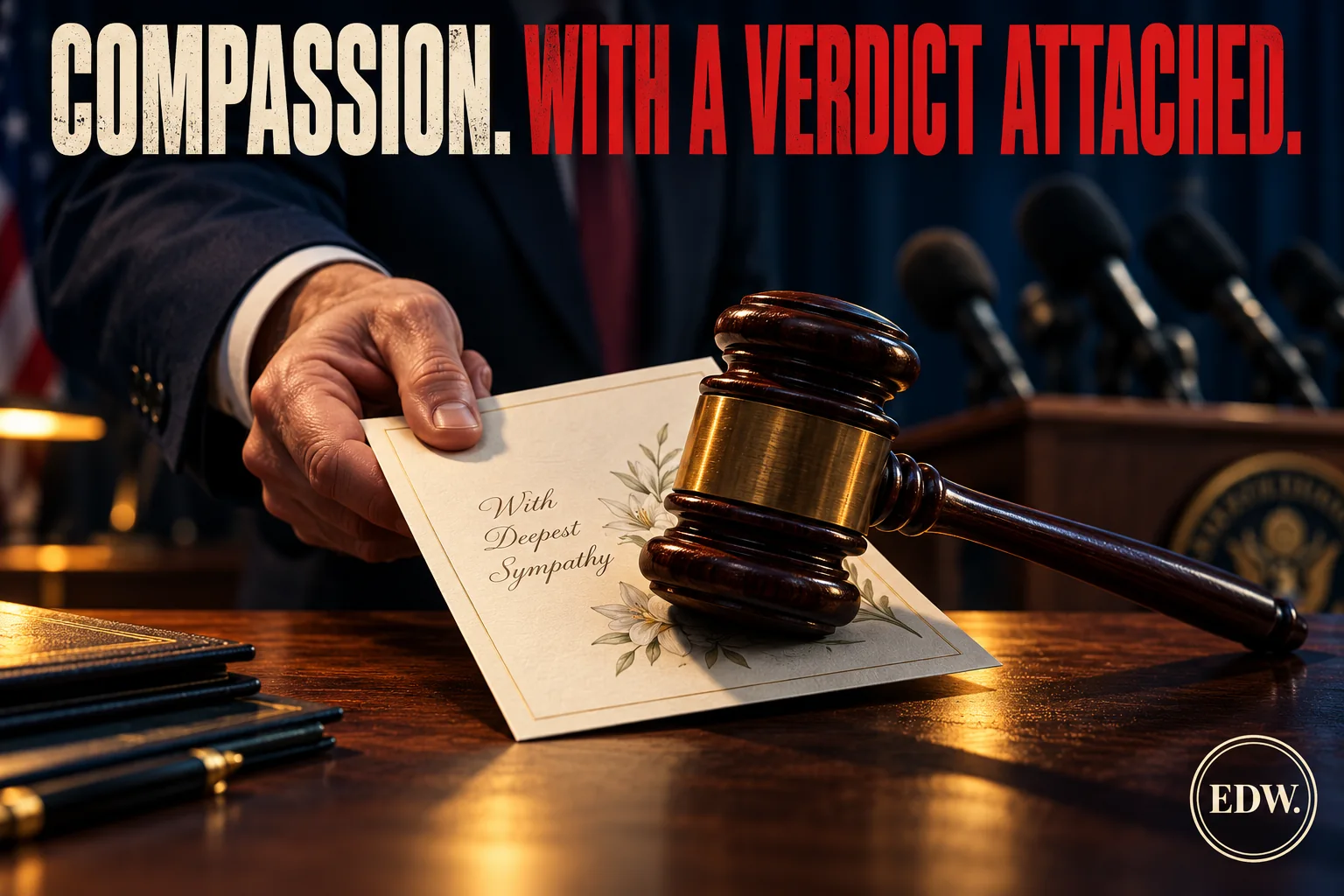
That’s a remarkable new form of compassion: the kind where your empathy arrives pre-packaged with a verdict, a political diagnosis, and a tidy moral lesson about the dangers of “the far left.” It’s like sending condolences with a subpoena attached.
Let’s pause on the logic, because it’s doing acrobatics. On one hand, she’s a “victim” who was “brainwashed.” On the other, she’s part of a sinister “left-wing network” and the whole thing is “a tragedy of her own making.” So she’s simultaneously a manipulated pawn and a fully culpable villain. That’s convenient: whatever happens, the administration gets to blame ideology instead of examining conduct, training, tactics, or accountability.
Notice the speed-run from incident to propaganda. Within hours, federal officials were already using the “domestic terrorism” label. Not “this is under investigation,” not “let’s gather facts,” but straight to the biggest, scariest noun in the political thesaurus. When your first instinct is to brand a dead citizen a terrorist before the evidence is fully known, you’re not informing the public, you’re preloading the jury.
Here’s the next trick: Vance says he isn’t worried about prejudging an investigation because “what you see is what you get.” Right. Except what we actually “see” (per multiple video reviews) is complicated and contested, enough that even mainstream coverage notes it isn’t clear whether the vehicle made contact with the officer, and analysts have pointed out she appears to be turning her wheels away as shots are fired. So “what you see” is… exactly why adults wait for investigations before handing out indictments.
But sure, let’s pretend a press-briefing hot take is a substitute for evidence. Who needs a full fact pattern when you can declare certainty from the podium?
About that “defend his own life” line: no one is saying officers should be harmed. The question is whether deadly force was necessary in that moment, and whether federal officials can credibly answer that question while simultaneously freezing out local oversight and racing to brand the dead woman a “domestic terrorist” before a complete investigation is done. If your first move after a shooting is to litigate it on cable news, you’re not seeking truth, you’re managing narrative.
Fox itself has reported that none of the agents involved were wearing body cameras. By January 9, footage recorded on the shooting officer’s cellphone had also been published and shared by federal officials. That footage adds another angle; it does not replace a complete investigation or a body-camera record.
Then there’s the rhetorical magic trick: “What young mother shows up and decides they’re going to throw their car in front of ICE officers?” Notice how that framing does all the work. It assumes motive (“decides”), it assumes intent (“throw their car”), and it assumes the only explanation is political mind control. Because God forbid we entertain mundane possibilities like panic, confusion, conflicting commands, fear, or the chaos of masked federal agents converging on a car in a residential neighborhood.
If Vance truly believes she was “brainwashed,” then the grown-up response is to ask what escalated the situation and how to prevent it next time. You don’t prevent “brainwashing” with bullets and press releases. You prevent tragedy with clear procedures, de-escalation, transparency, and yes, body cameras. You prevent it by not turning every death into a political fundraising email.
What Vance offered instead was a two-for-one special: justify the shooting and smear the dead, then pivot to unrelated political grievances (including a fraud crackdown announcement conveniently centered on Minnesota). It’s almost impressive. One moment we’re told to mourn, the next we’re told to rage at “Democrats,” “the media,” and an amorphous “left-wing network.” That’s not leadership; it’s a culture-war ventriloquist act.
If you want to argue self-defense, argue it like an adult: stick to the facts, accept uncertainty where it exists, and support a transparent investigation. If you want to argue that protests should be peaceful, fine, then say that without simultaneously granting “absolute certainty” to a story that is still under review.
A politician calling a dead woman “brainwashed” isn’t a moral argument. It’s just partisan theater, performed over a body that, apparently, must be made useful for someone else’s talking points.
Start by demanding facts before verdicts, and accountability before ideology.
EDW•